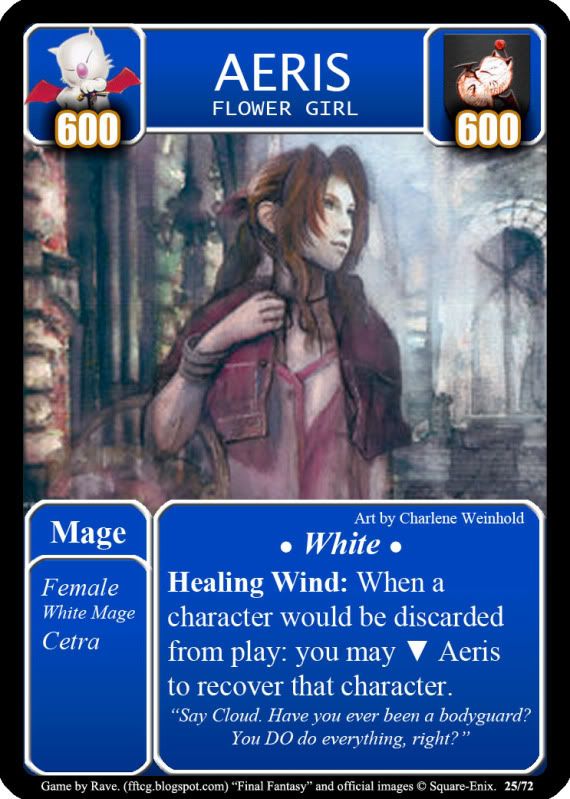
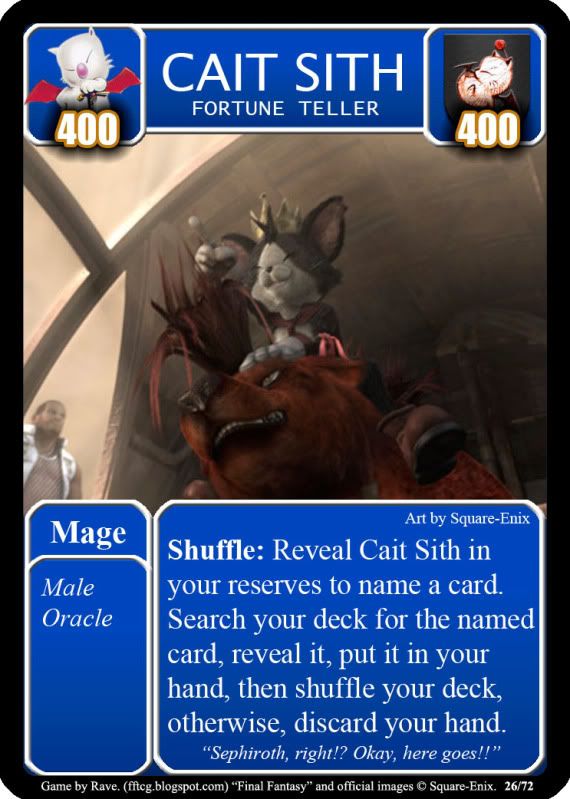
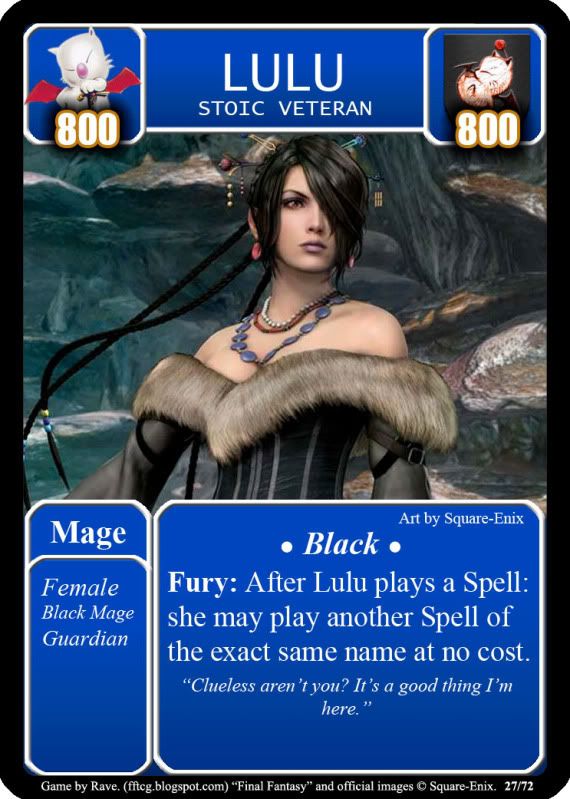
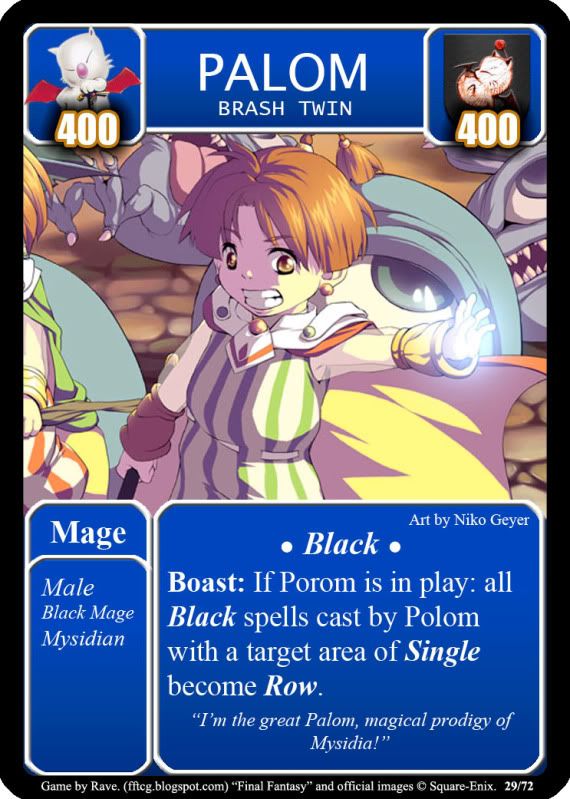
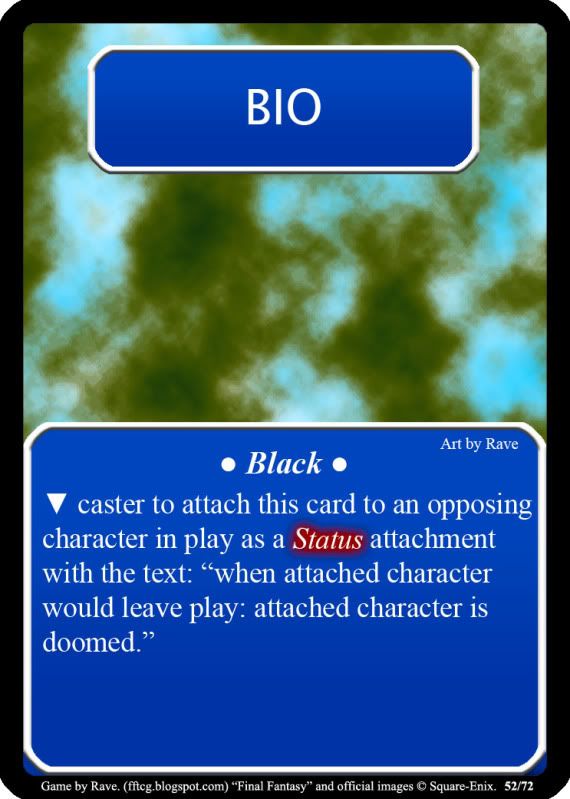
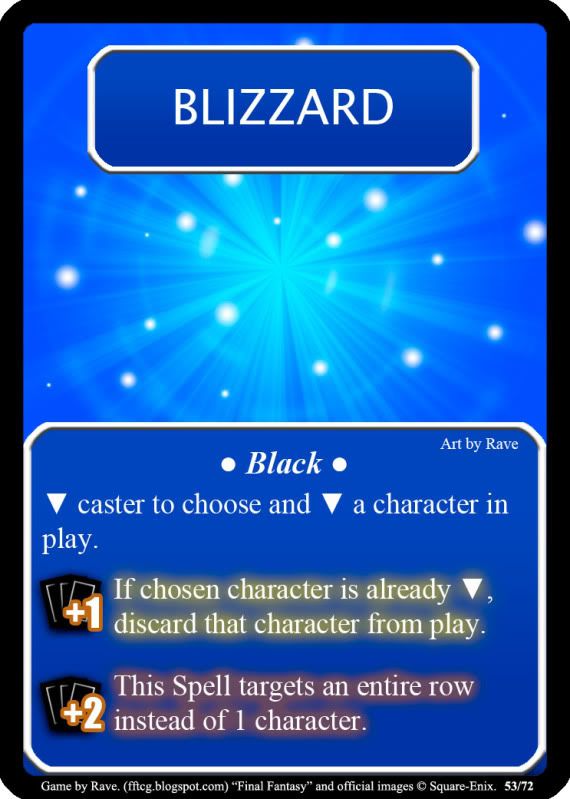
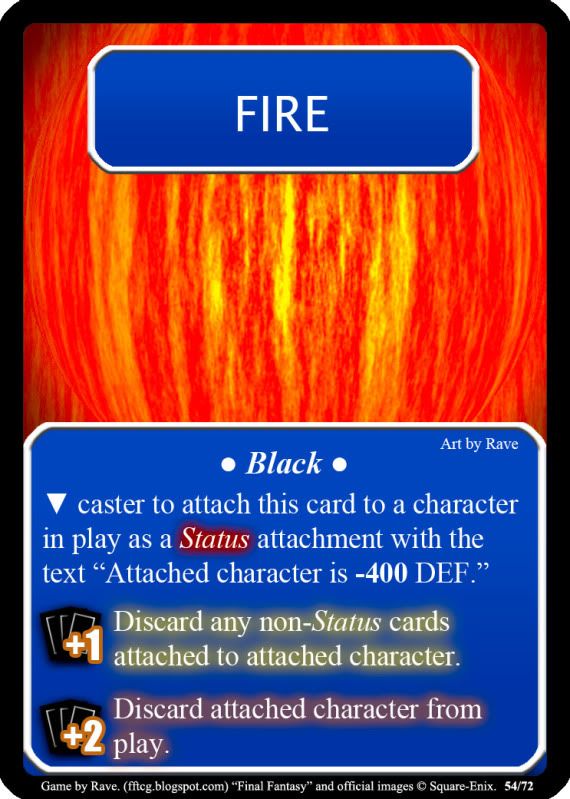
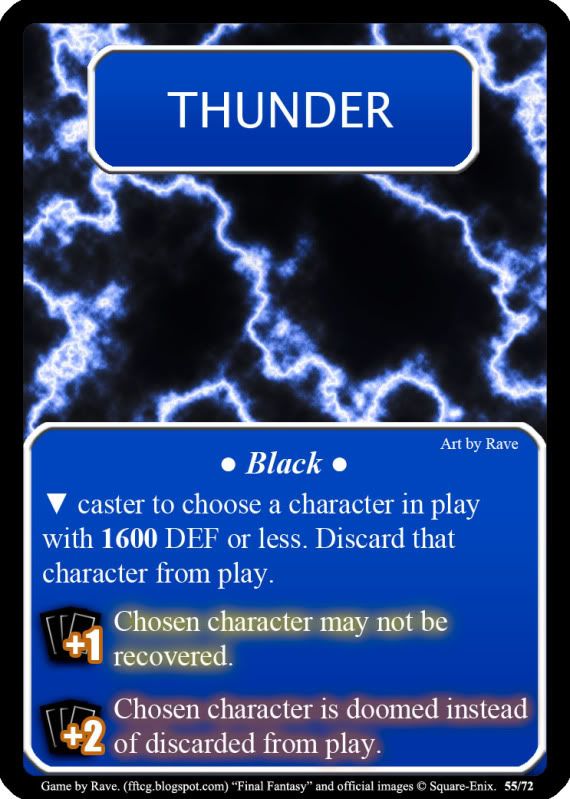
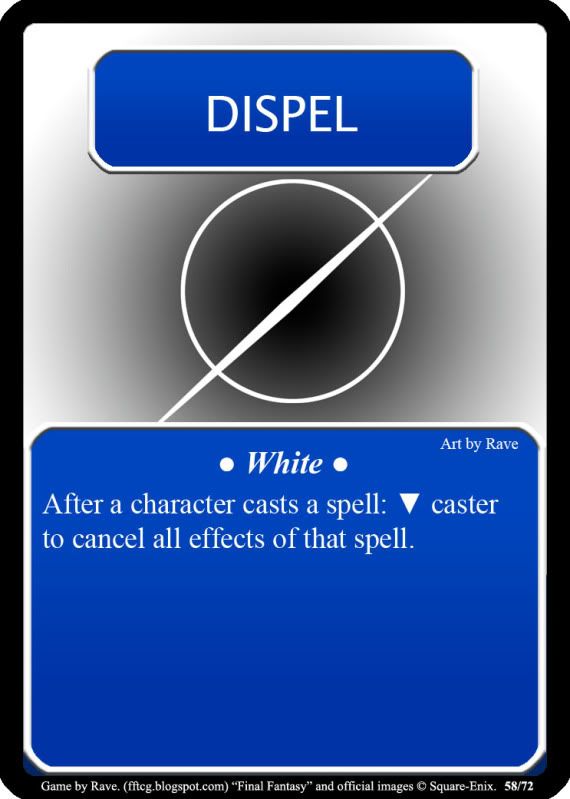
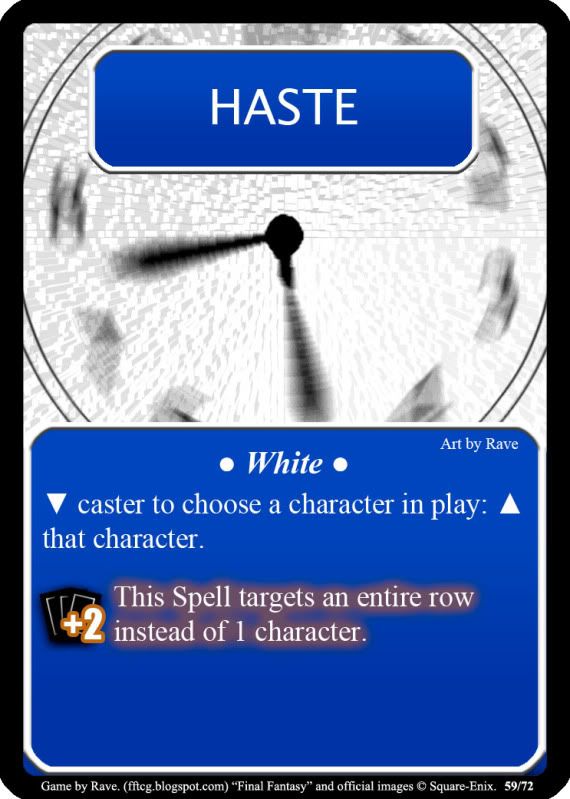
So the game had its first playtest, and I must say, it was better than I thought it would be.
(Granted, my expectations were pretty low)
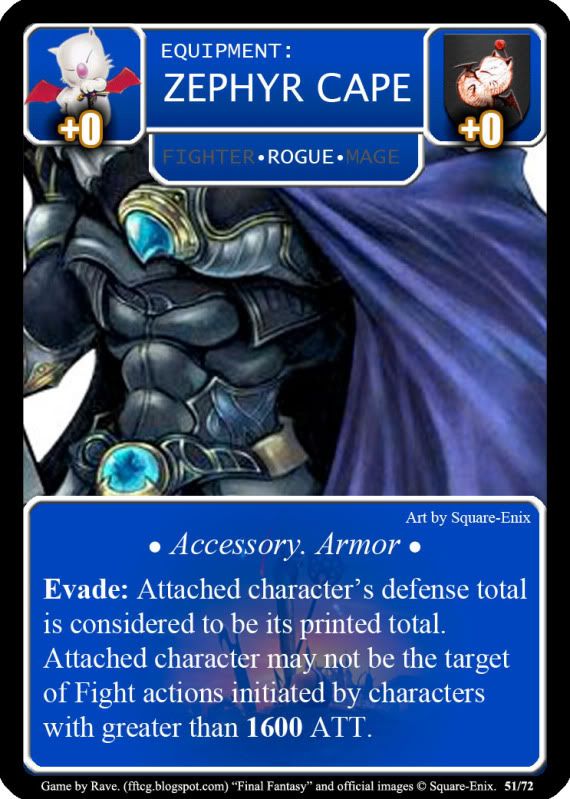
The game seems fundamentally balanced, as long as I don't break a few concrete laws I set for the characters... (no base ranged characters with 1600 attack or higher probably being the biggest.)
I think my biggest fear initially was the fighter type characters overrunning the other characters. But when I ended up playing, they had their just had their role like the others, as opposed to steamrolling through everyone. Spells didn't seems underpowered to the point of being obsolete, either.
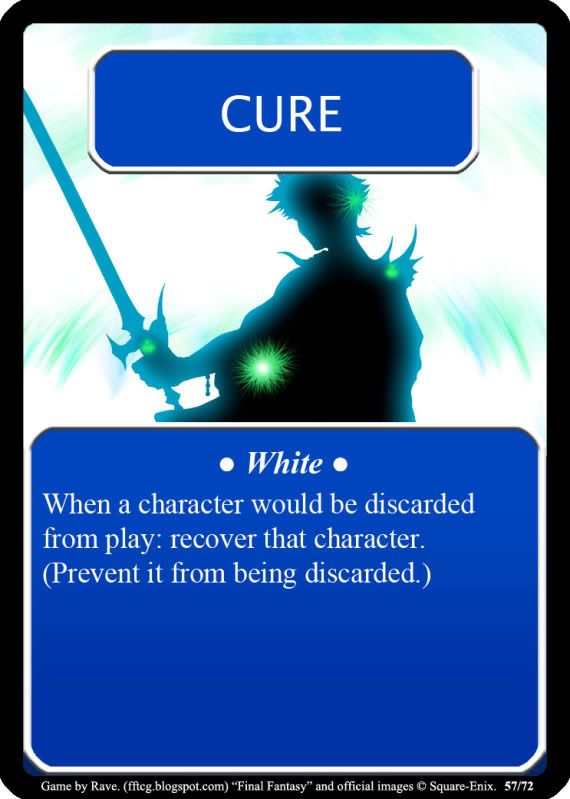
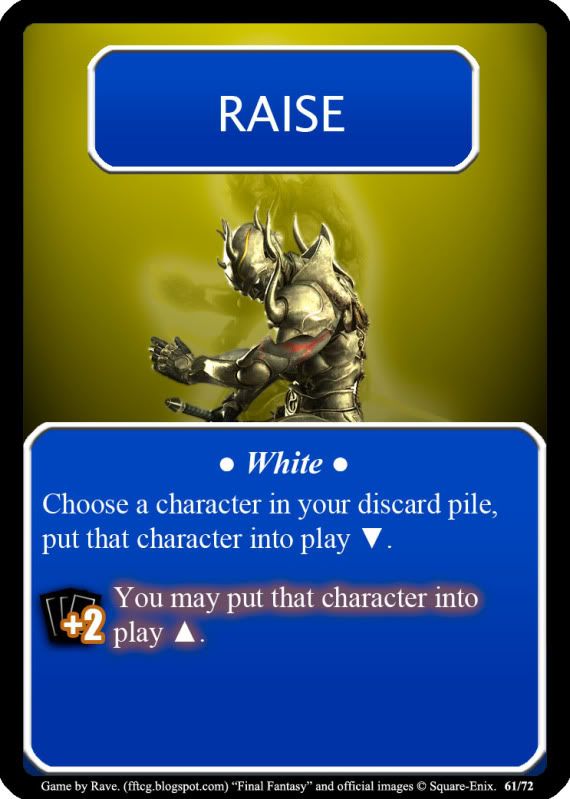
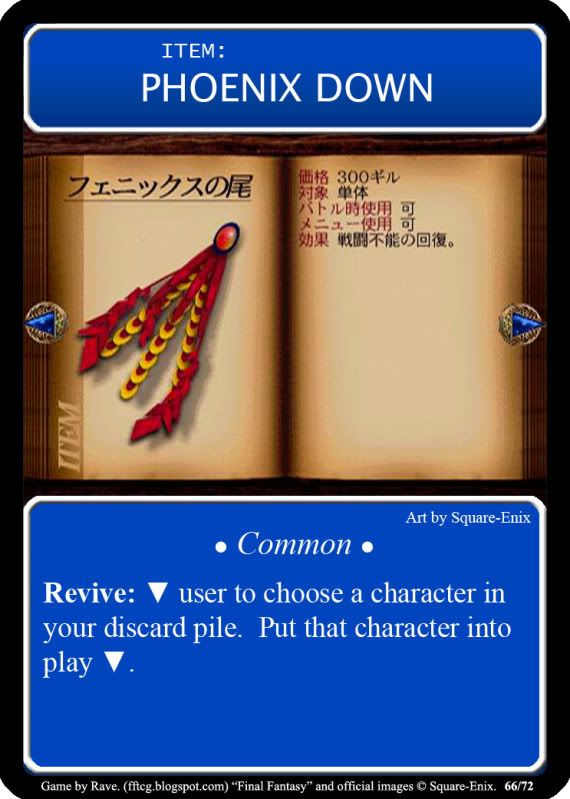
One thing, that we did notice, is that Phoenix Down and Raise are two VERY powerful, and abusable cards.
Phoenix Down:
Tap user, search your discard pile for a character and put it into play tapped.
Raise:
Target caster, search your discard pile for a character and put it into play tapped.
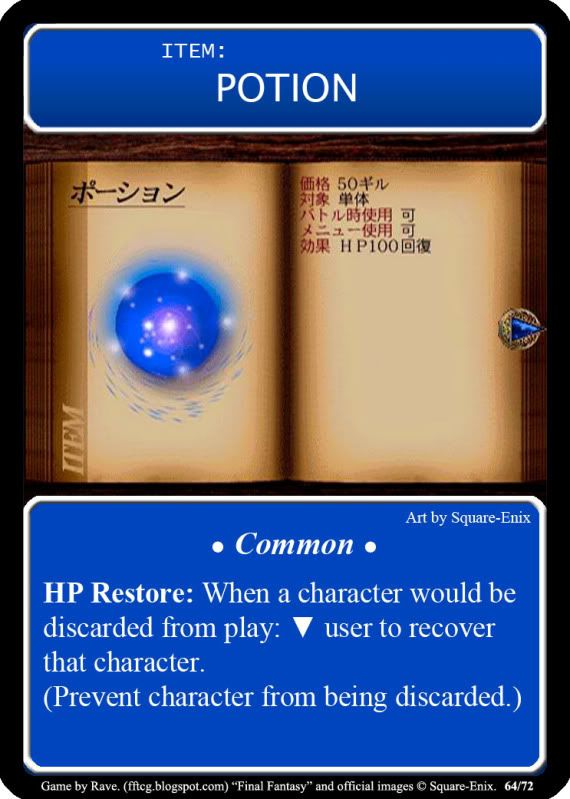
(More efficient version of potion for white mages...)
The thing about this is, we saw Auron 5 or 6 times that game due to discard pile recursion, which doesn't seem to be very healthy for the game.
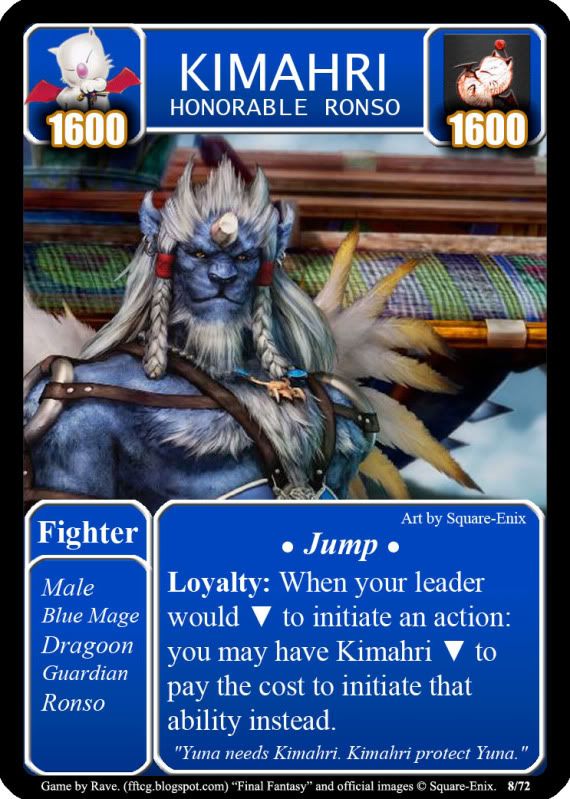
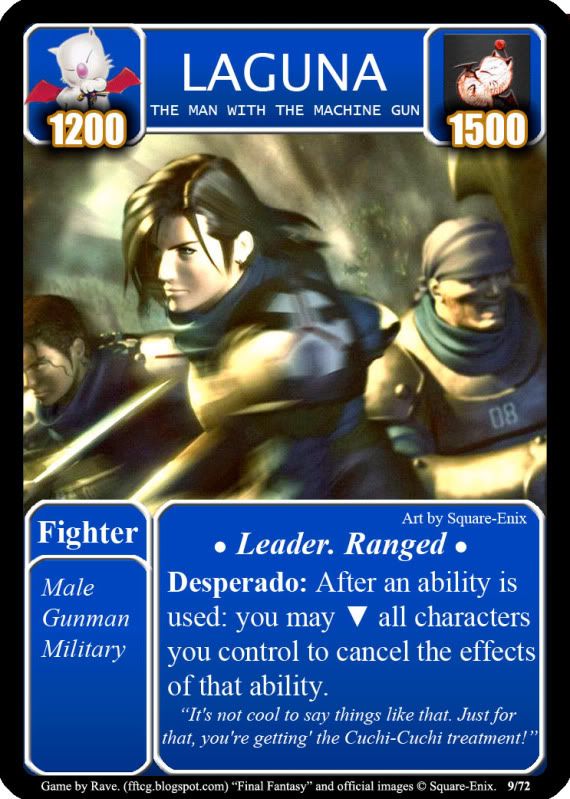
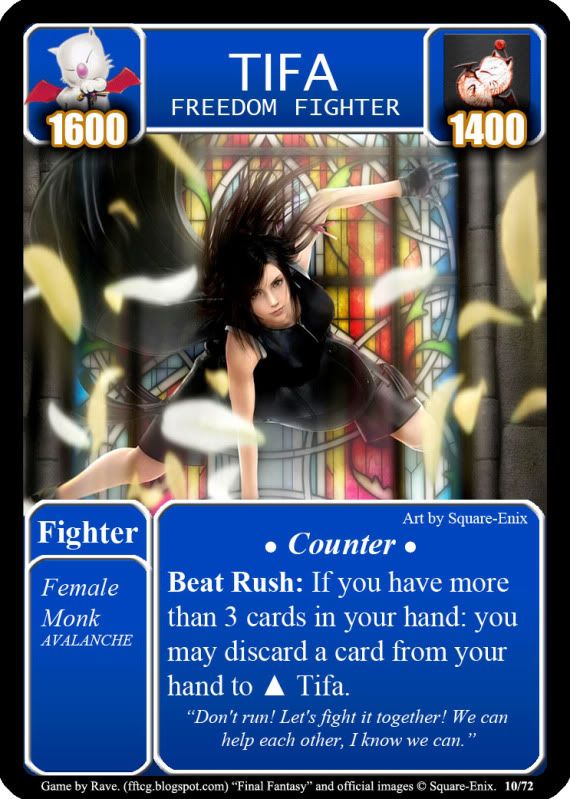
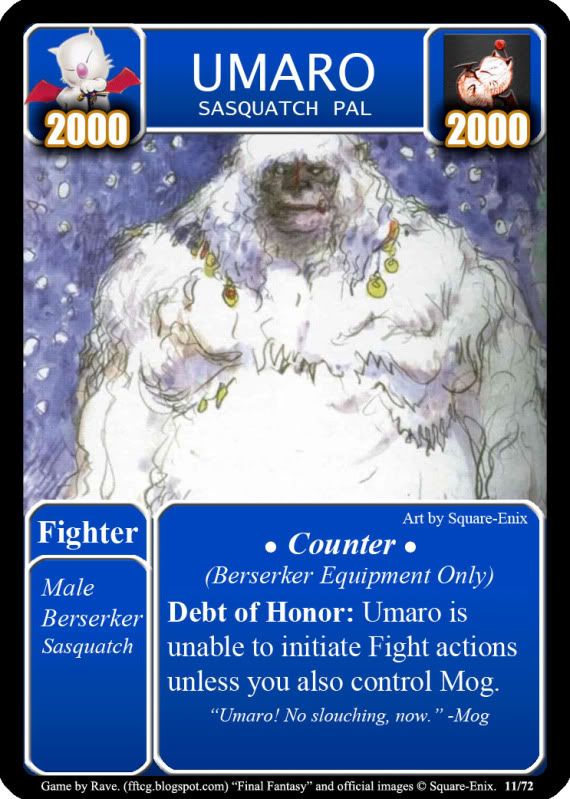
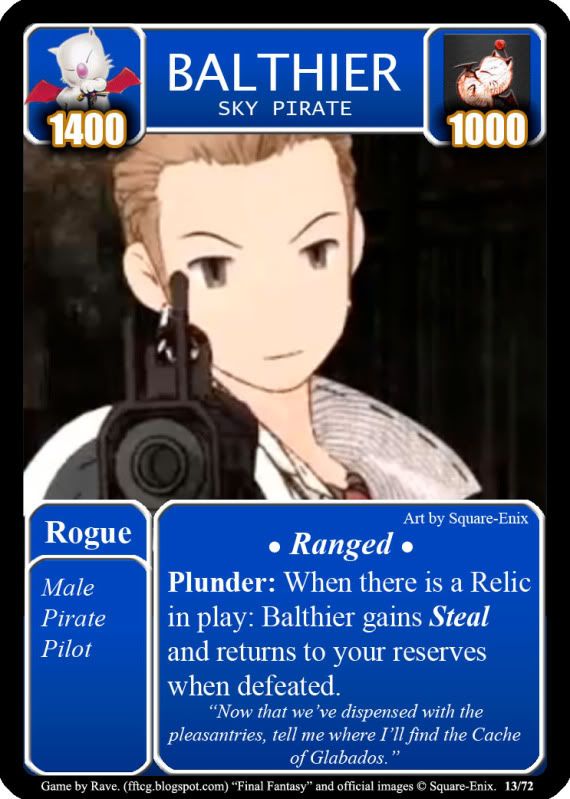
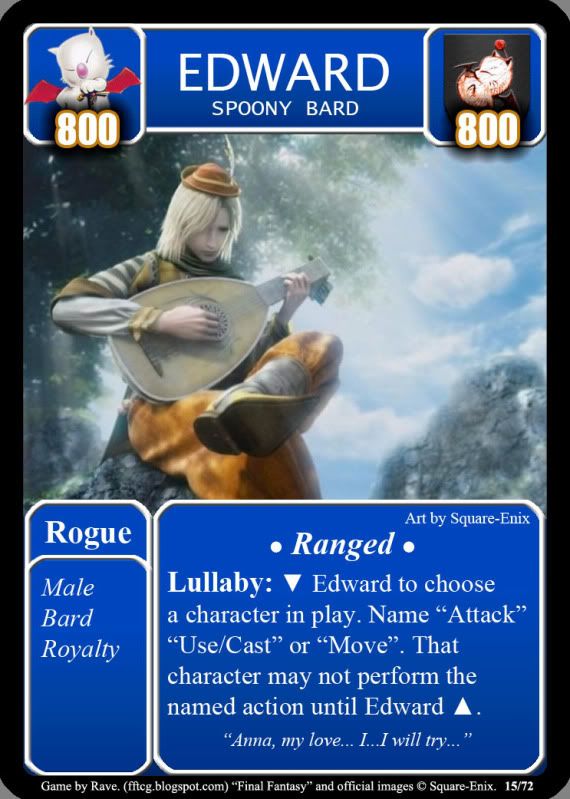
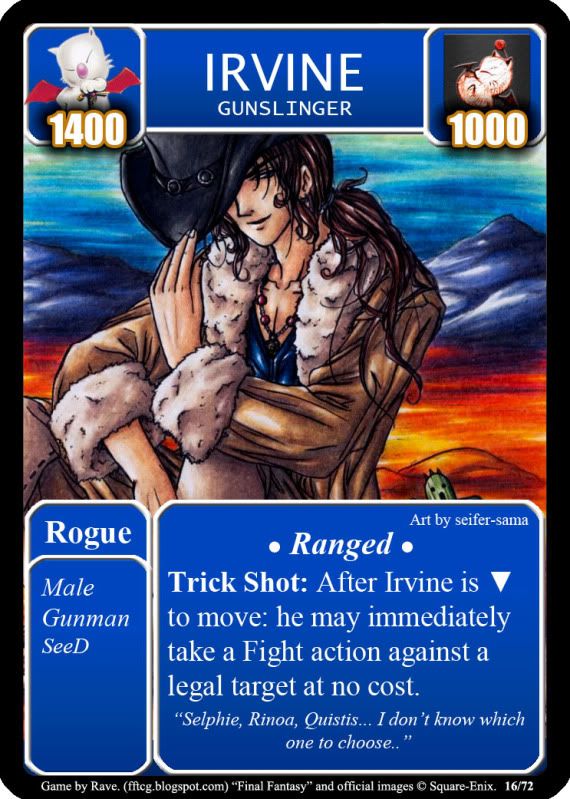
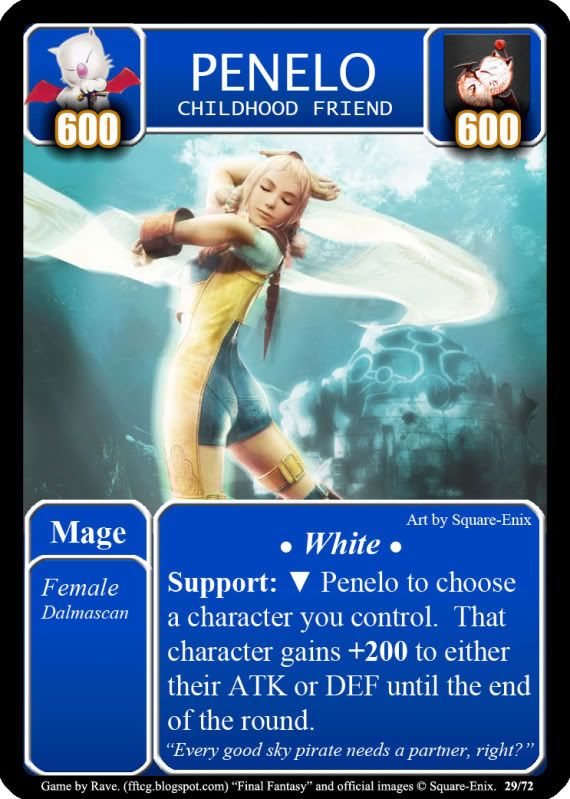
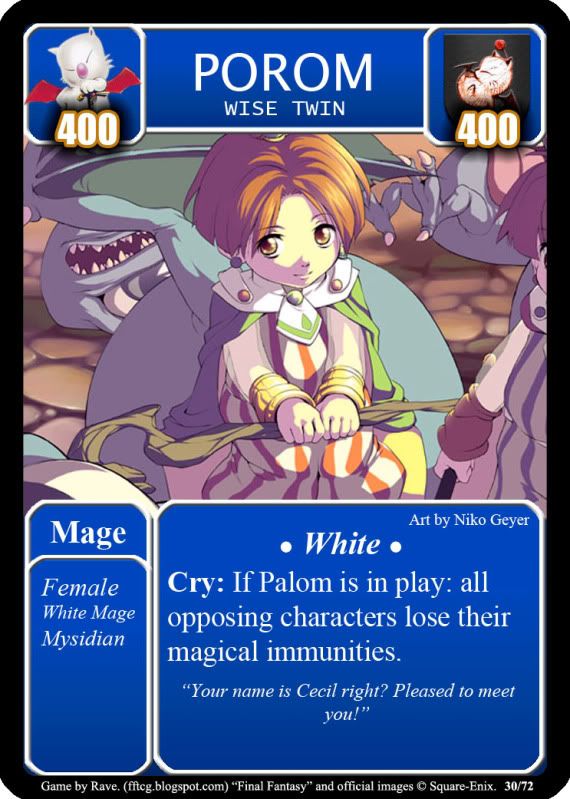
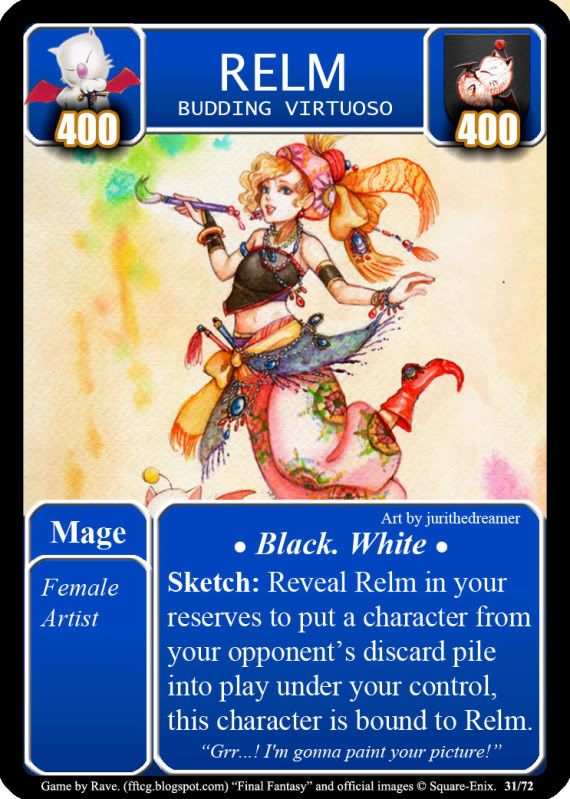
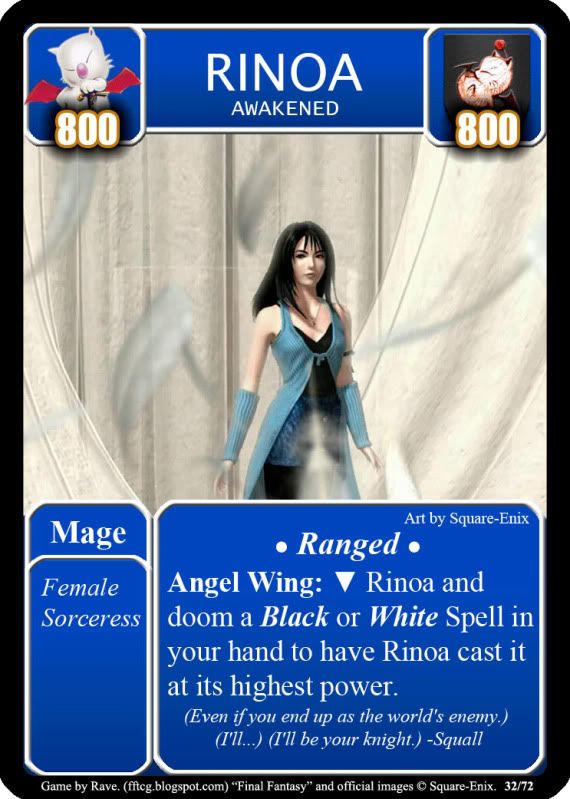
Sorry I can't show the cards yet, I've been too lazy to email the artists about the use of their art, but I'll give you some text.
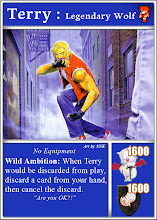
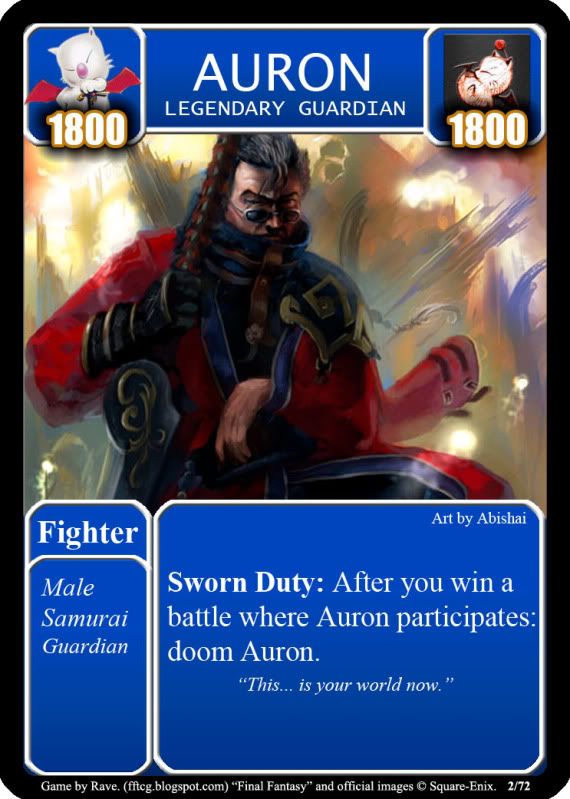
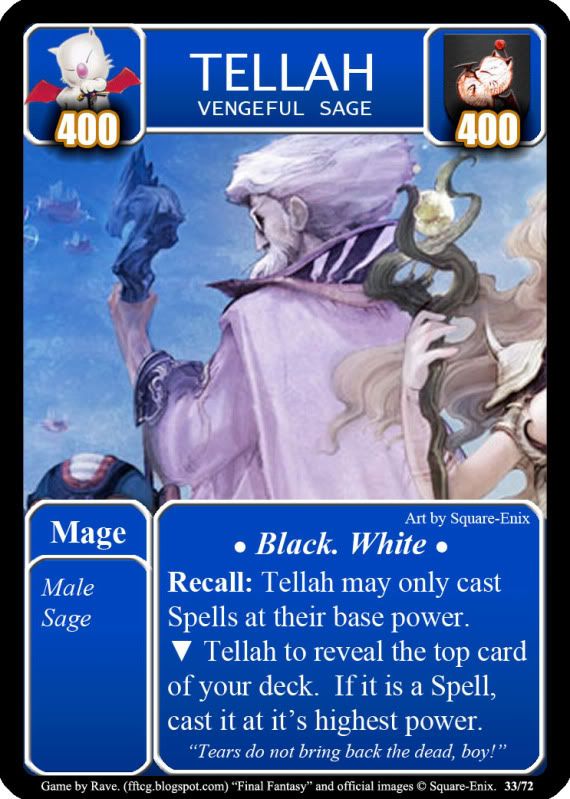
-Auron-
1800 Attack/ 1800 Defense
Sworn Duty: At the end of the battle, discard Auron from play.
Really, he's all stats, and in my opinion, he's the strongest hero in Final Fantasy (lore speaking), so he deserves it, but we can't have him popping in every 2 seconds for tea...
So due to that, I've decided to create a separate remove from game pile, and Auron's ability will now move him to that instead. He can still come back when he is killed, but if you win with him, that should be it, he's done his duty, he's gone. This mechanic will also be implemented for Bahamut, and the Gunblade. The only plans I have for cards being returned from the Remove from game pile is Phoenix, but I haven't even brainstormed that yet.
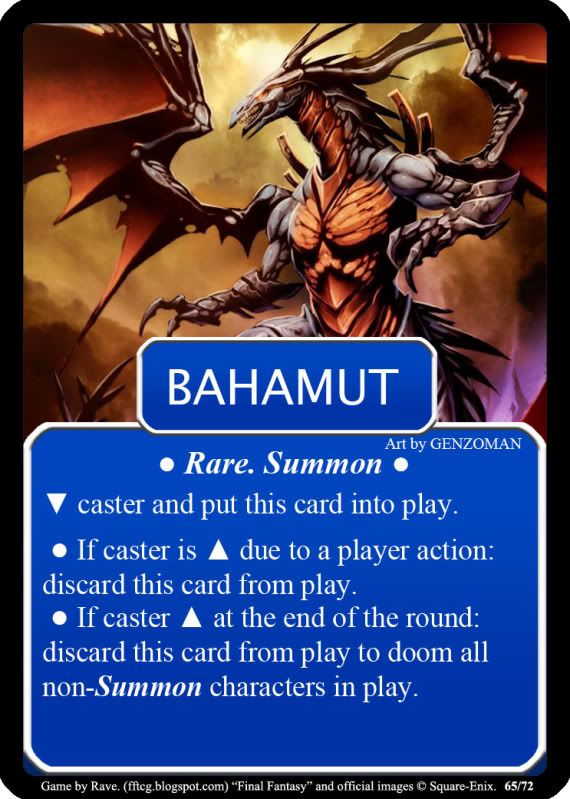
-Bahamut-
Summon.
Tap caster and put Bahamut into play, when caster readies, remove all non-Summon characters from the game.
(This is probably going to be the nastiest summon you will ever see)
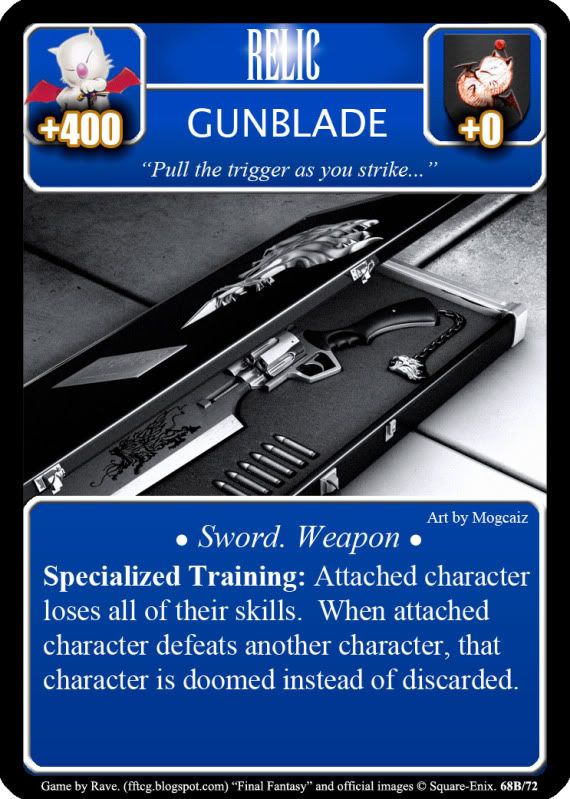
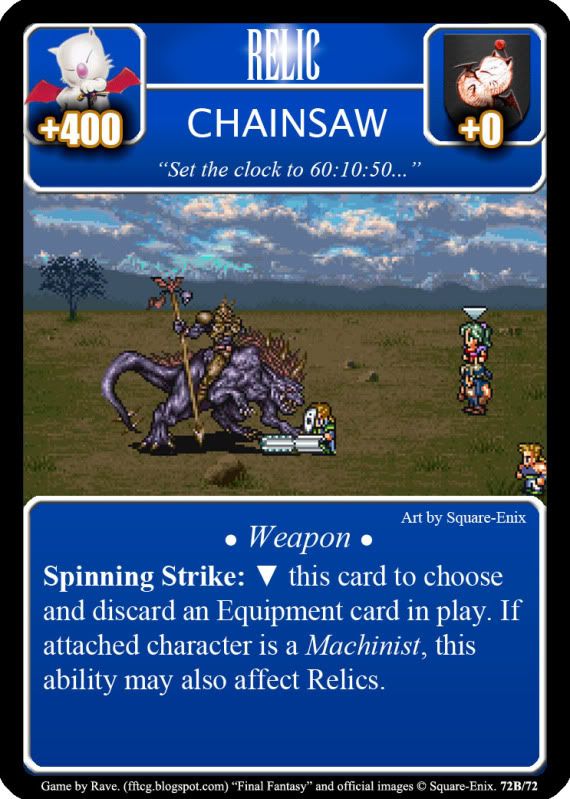
-Gunblade-
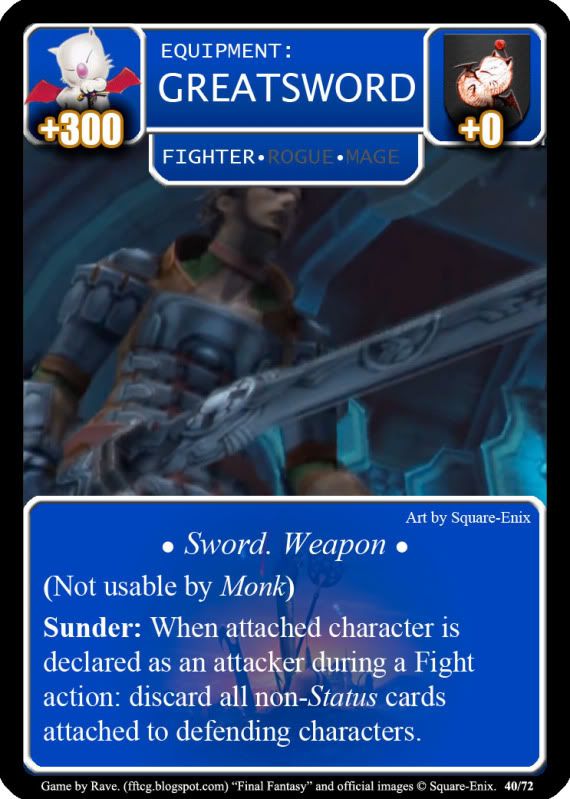
Relic. Sword. Weapon.
+100 Att
Specialized Training: If attached character has no traits, (that's stuff like "white" "ranged" etc) characters they defeat are removed from the game instead of discarded.
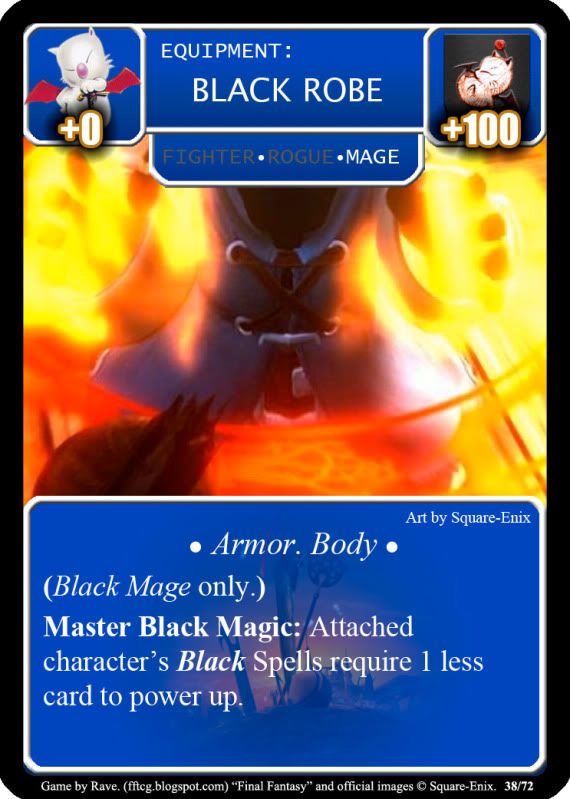
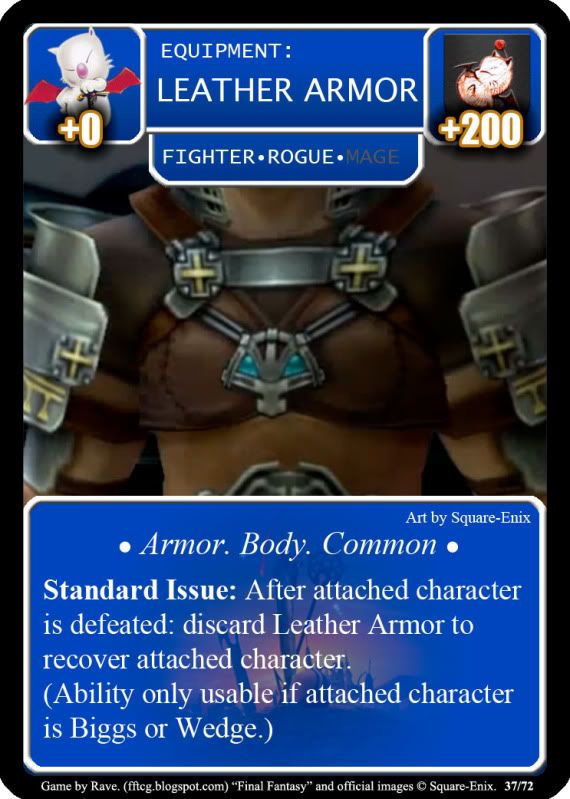
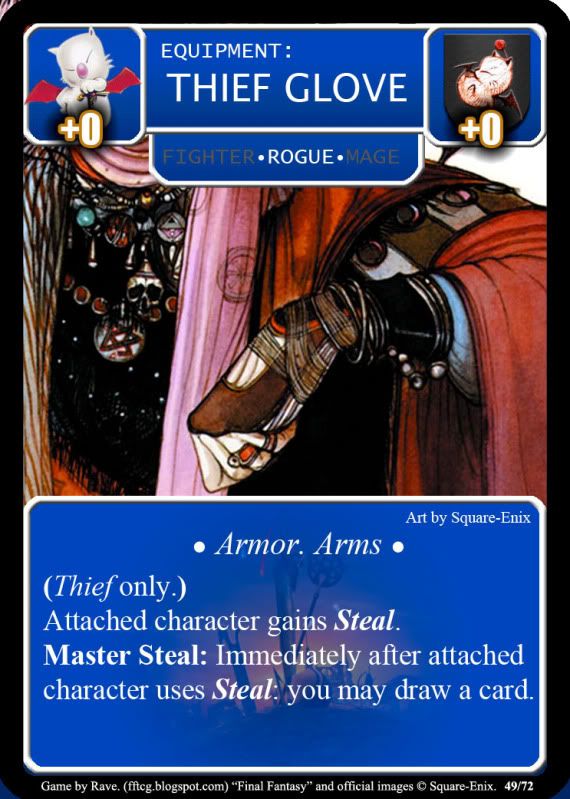
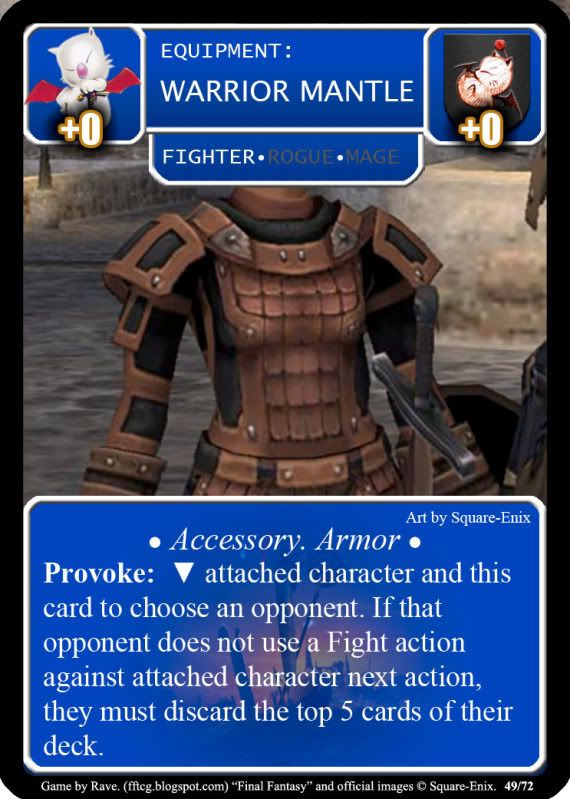
We also dodged a bullet with Bangle, the generic armor card of the playtest deck. All it really did was increase defense by 100, but we ran into a problem when giving these to 1600 defense characters. They were near untouchable, and there were a few cards that could deal with them, but I think such an integral gameplay mechanic shouldn't have to be dealt with by silver bullet type cards.
In the end, we decided that Bangle will be:
Bangle
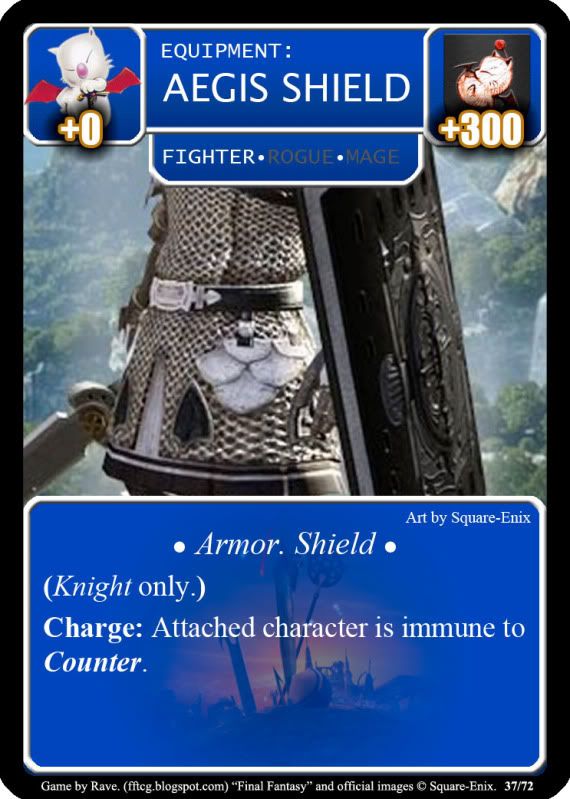
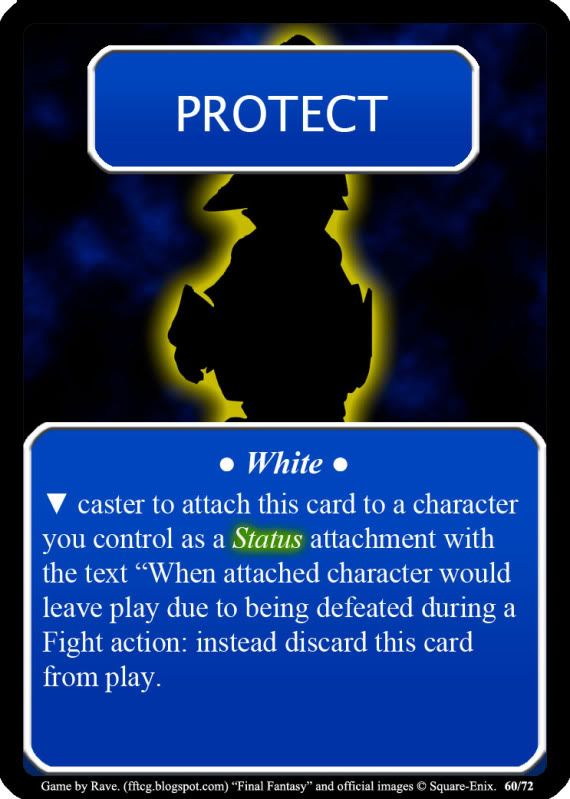
When attached character would be discarded, instead discard bangle from play.
It's like a pre-emptive potion or cure spell, (same vein as phoenix down:raise) except with one difference. Potion and cure are considered to be "Recovery" abilities, and there are cards and characters that bar Recovery cards or abilities from being used. Bangle doesn't carry this keyword, and is immune to those effects, on the flip side though, there are no plans to have armor be recursive, so I don't think it will end up being abused.
So anyway, I played with my friend Mitch, who doesn't play ccgs on a regular basis, but nonetheless has a good mind for this type of game. I asked him for his top 5 characters, and here's who he chose. Along with some of my commentary.
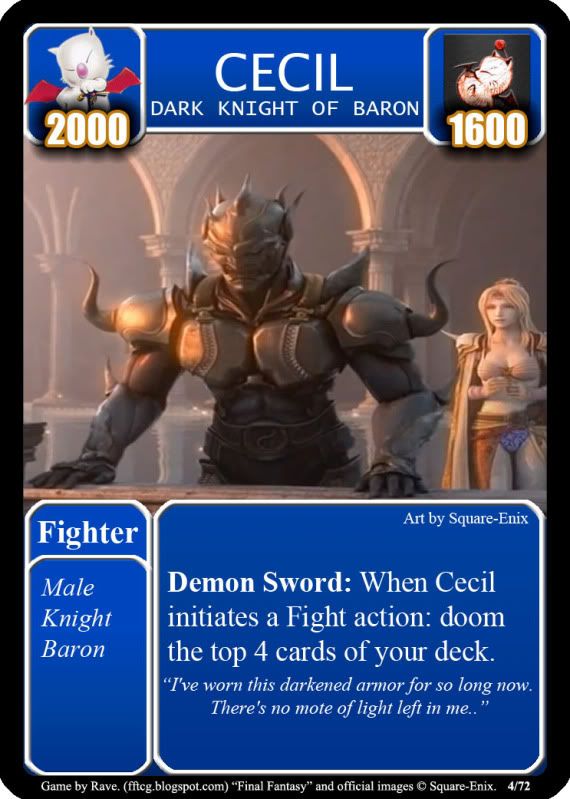
1. Cecil
-He's a wall, I was really having trouble dealing with him, Aeris, and Cyan in tandem. (Aeris is kind of like a portable cure) Cyan has 1400/1600 and gets +400 att while counterattacking.
2. Auron
-The stats purely, Mitch kept bringing this bastard back into play like every match.
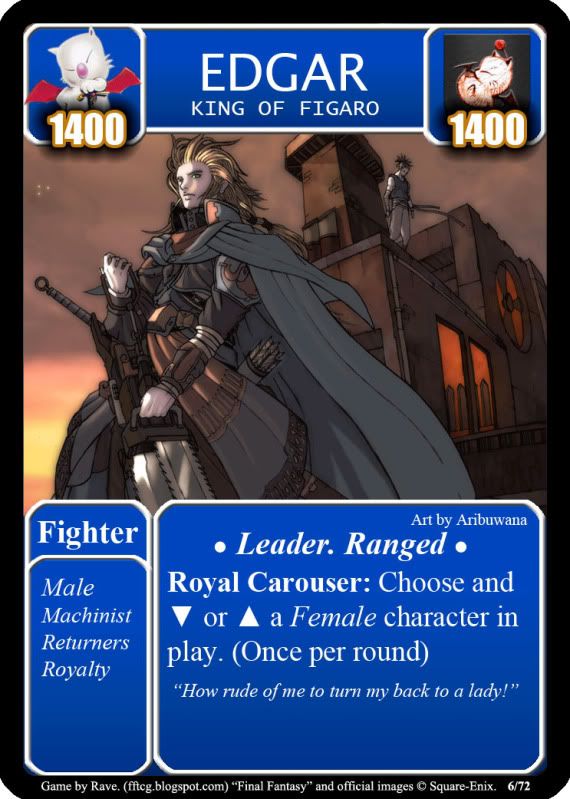
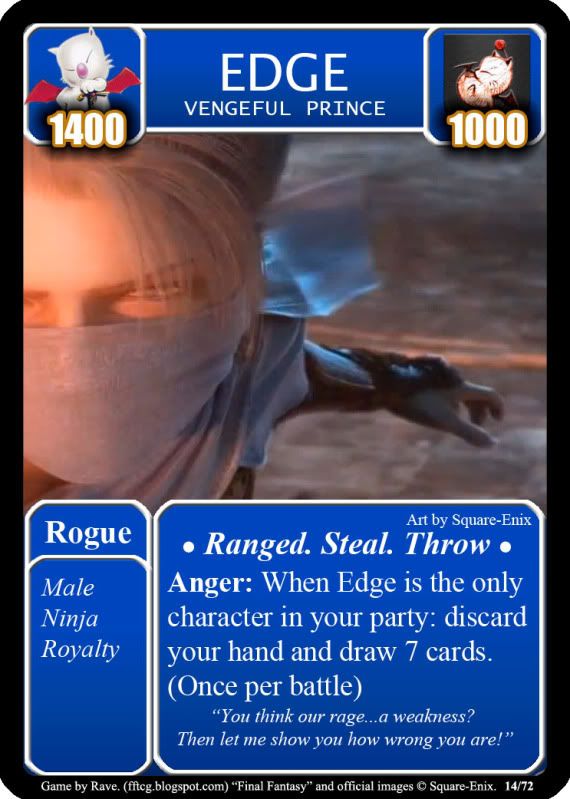
3. Edge
1400 att/1000 def
Ranged.
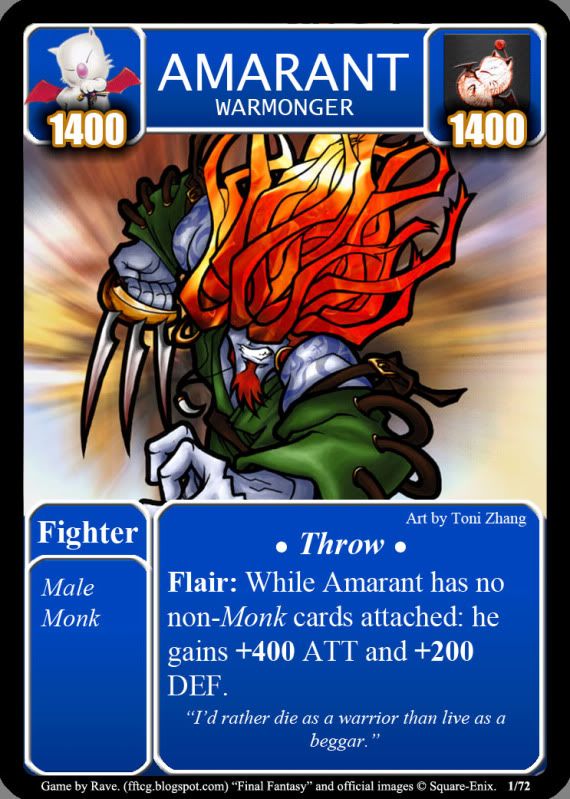
Vendetta: When Edge is the only character in play, he gains +400 attack and +600 defense.
-Mitch liked him for the clutch value, and he IS an interesting card, he and Amarant are the only two cards that come dangerously close to breaking that concrete rule I spoke of earlier.
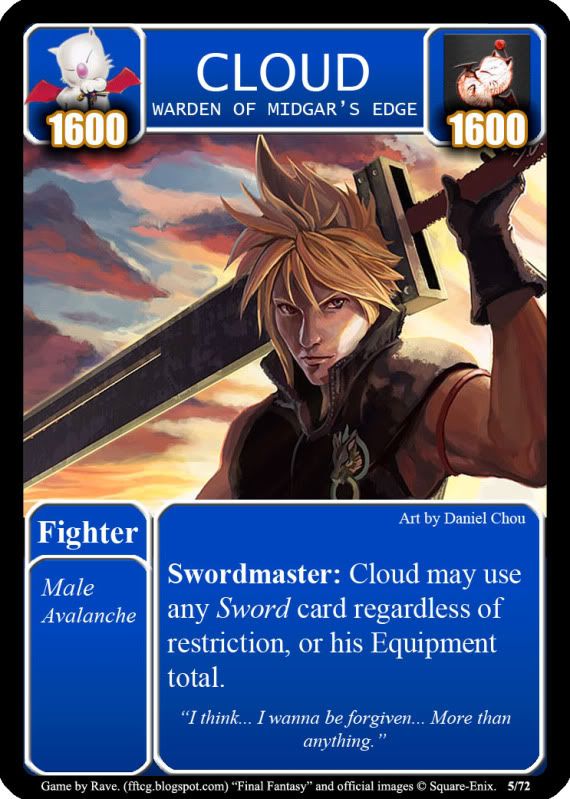
4. Cloud
1600 att/1600 def
Swordsmaster: Sword cards do not count towards Cloud's equipment total.
(Each character may only attach one card at a time, Cloud can attach one, and all the swords he wants)
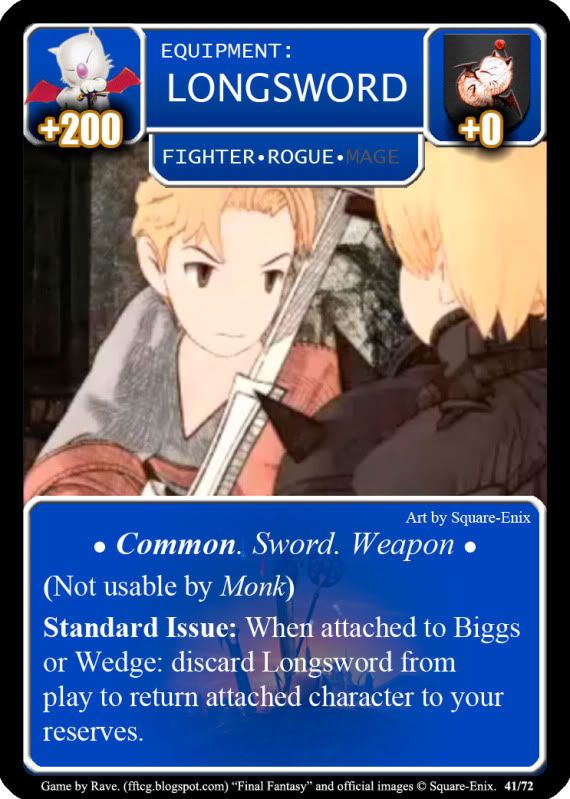
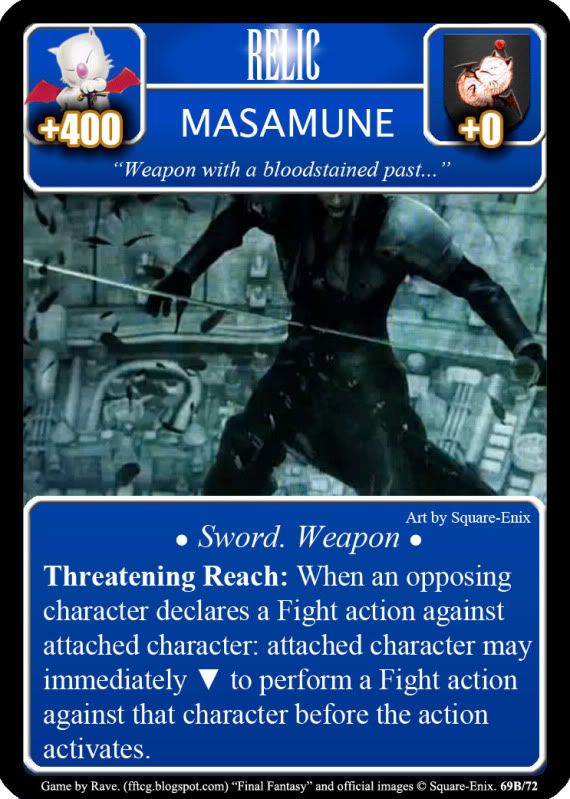
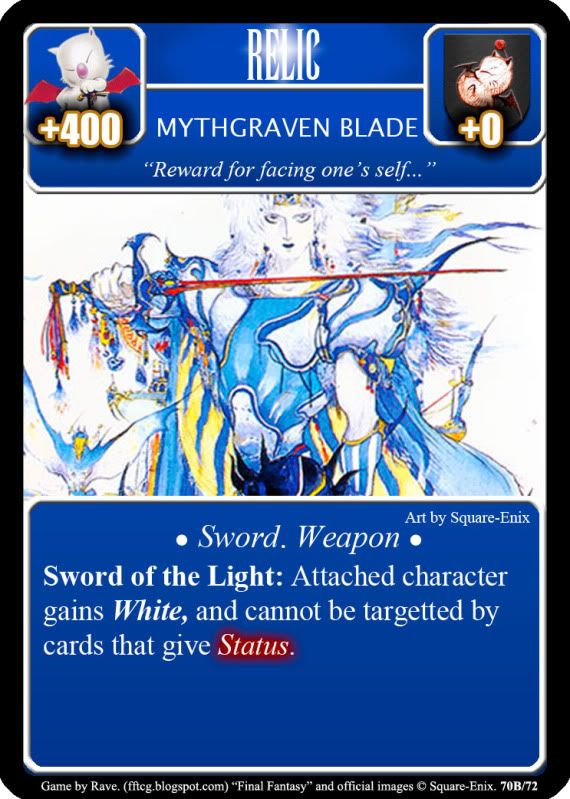
-This was surprising to me, because the initial playtest has no relics, but Mitch made him work with a Mythril Sword (+200 att) and a Bangle in tandem. It really made him a force to reckon with. He'll get better later though. With the relics in play, there will acutally be 4 in game swords (Mythgraven Blade, Gunblade, Masamune, Mythril Sword)
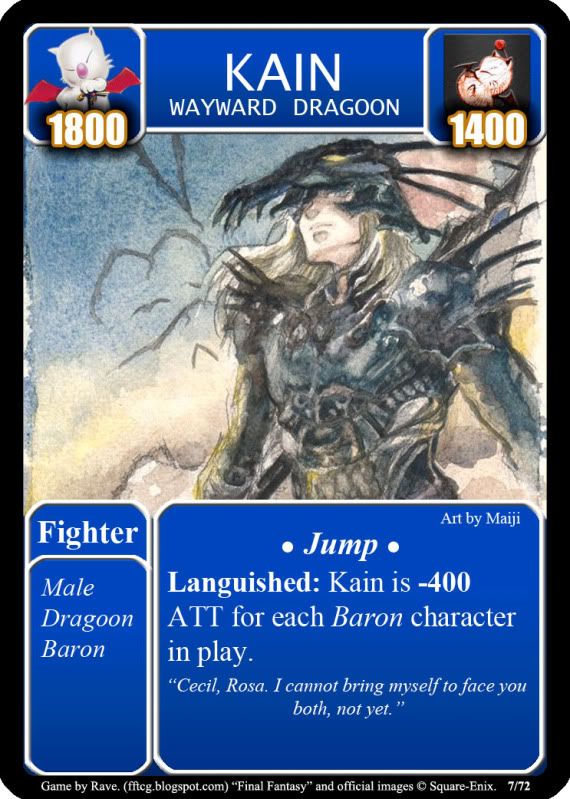
5. Kain
1400 att/1400 def
Jump: When Kain comes into play in the battle phase, he may immediately make an attack on any character at +400 att.
(This is a one shot, and only available when Kain is played mid-battle)
-This was brought on by Mitch playing his characters conservatively, and while he only had 1 out, Kain came out and won me the match. It was then we both saw he had real ninja potential (for not actually being a ninja at least)
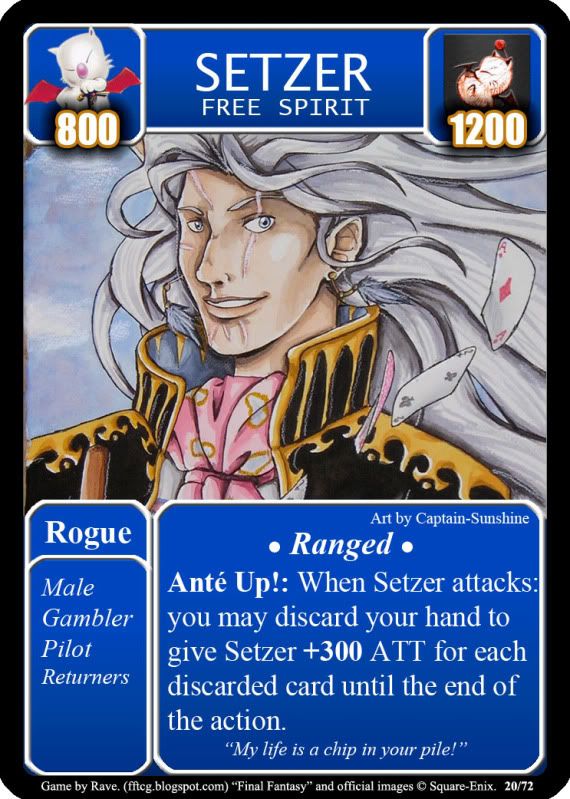
When I asked if there were any characters he thought were underpowered, he mentioned Setzer...
Setzer
800att/1200def
Ranged
Ante Up:When Setzer attacks, you may discard any amount of cards from your hand, this attack gains +300 att for each card discarded.
-Mitch thought he was underpowered, because he felt he only had one shot, and then was pretty much fodder. I do see the merit in that, but at times on my side Setzer was the only one who could really deal with Auron's 1800 defense.
It's on the watch list for sure, but we'll see how it goes.
Location/Relic proxies are printed up, I'll let you know how they go, soon.
Sunday, April 26, 2009

Monday, April 13, 2009
Ugh.
Yeah... that point based balancing thing I mentioned... not gonna happen.
Cecil kills them all... according to my templates there is no reason in the world why someone with a magic keyword should have 1600 defense, but I feel like he isn't going to be broken in the actual game. Oh well, I guess that's what play testing is for, right?
In other news, all of the characters are done. Whew!
For anyone that wants to know what the playtest decks will contain, here's what I've decided.
30x characters
3x Cure
3x Raise
3x Protect
3x Fire
3x Blizzard
3x Thunder
4x Potion (you can use any # of the item cards, the 3 card limit does not apply)
4x Phoenix Down
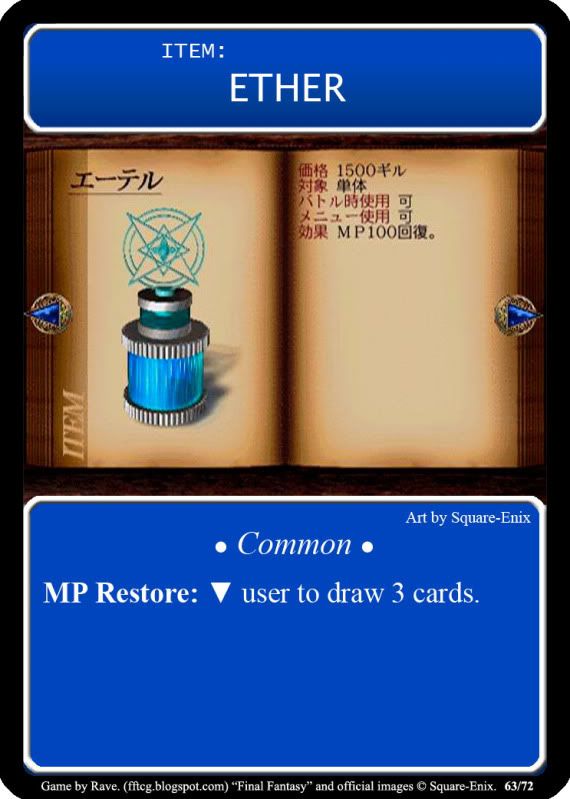
4x Ether
1x Ifrit
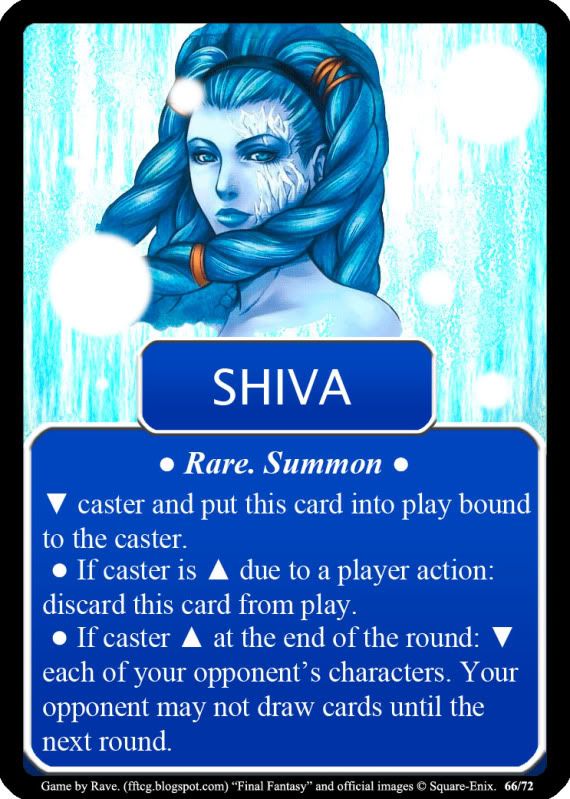
1x Shiva
1x Bahamut
1x Ramuh
Then the location/relic deck, these are still being worked out, but trust they will be done soon.
I might post a couple cards up soon, and explain my thoughts about them...
Monday, April 6, 2009
The horrors of balance
I don't know if anyone knows this, but once upon a time I used to be a pretty hardcore A Game of Thrones player. (Unfortunately, hardcore does not necessarily equate GOOD, I certainly did well within my own meta, but I'd always crumble under other meta's control decks, and things of the sort)
Anyway, because we were so wrapped into this game, I got to know the designer pretty well. His name is Eric Lang, and he was this sarcastic skinny guy from Canada who had never eaten hot wings in his life. I remember him saying one time "Man, I've got the idea for hundreds of cards in my head, I just have to worry about balancing them, that's the bitch" He's right, and this is the part I hate.
Most card games have some sort of income system, something like "Batman costs 6 to play, because he's the bane of every criminal in Gotham, but Robin only costs 2, because he's a college kid that wears tights."
A Game of Thrones, even, had cards that cost up to 10 gold. Final Fantasy is weird in the sense, that there is no income mechanic, which means instead of 11 (0 also counts) balance points for characters (Where 0 is the worst character and 10 is godlike) there is only one.
On paper, this makes the game a lot less complicated, but it will also make cards harder to make, because they will all have to meet the exact same standard, or it will end up like Marvel Vs Capcom 2 with everyone picking the same 8 characters in a 56 character game.
I think that based on my prior card game experience I can do this free-hand pretty well. But I really wont know until it's played, so I'm thinking of trying to do it mathmatically. Something like giving each character a required point total, and giving every aspect of the card a point value. That way it will be easier to find overpowered and underpowered characters. I can imagine it getting awfully complicated, but it's something I'll be trying to figure out.
Wednesday, April 1, 2009
Rock Paper Scissors? General battle design.
This is something that I thought would be appropriate for the system of this game.
Instead of having units with arbitrarily numbered attack and defense totals, I tried to loosely have each type of character repel one of the others. By doing that, it gave me kind of a template to use for each character that I could modify to fit them without having to start from scratch. (And at the same time, keep units with high totals in both from dominating the battlefield.) What I didn't expect, is that almost every character in final fantasy (at least the amount that I did) almost evenly fits into the 3 classes, with only a few hybrids.
Anyway, here's the example I was getting at...
Melee Characters:Rock - Average stats: 1600/1600
Melee characters are the basic building block of your army. It's a good idea to have a few of these in your front line to protect the characters in the back, (because don't forget, when your front line falls, the back line moves up) They also can freely kill most other types in melee combat without falling themselves. Their big weakness is magic, because magic in the card game is very strong, and to a lesser-extent, other melee fighters, but you can usually get in a parting blow vs. them. Some characters, I felt were good fighters but a little lacking in constitution, so their defense can drop lower than 1600, but only in the rarest circumstance will it drop below 1400, for reasons mentioned later.
Mages:Paper -Average stats: 800/800
Yeah, if fighters are the baseball bats, these guys are the baseballs. It's no question that a fighter is going to defeat these guys without breaking a sweat. So naturally, any mage that values their head will be in the back row. The thing about mages is... well duh, they can cast magic. Magic will on average cleanly take out a fighter, the trade off is that magic cards come from your hand, they aren't printed on the character, so in other words you can't use them repeatedly. The other good thing about mages is that being able to cast magic also brings you resistance.
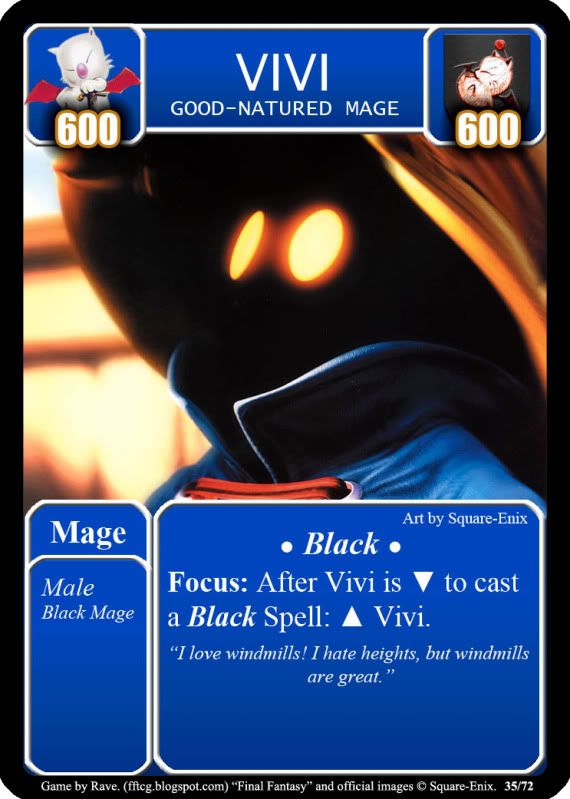
For example, Vivi has the "Black" trait, which grants Vivi the ability to cast black magic. But as an added bonus, as long as Vivi is standing, he can not be targetted by black magic cards. (I think I mentioned this earlier, but whatever)
Ranged Characters:Scissors -Average stats 1200/1200
Unfortunately for Vivi, there are only two rows, and that's where these guys come in. Characters with the ranged keyword ever so rarely break 1400 in their attack, which means at the base value, fighters are almost always immune to their attacks, but ranged grants the character the ability to shoot into the row behind them, giving them extra effectiveness vs mages, and so-so effectiveness vs other ranged characters. (again, that parting blow) One thing I've noticed on paper though, is that the ranged characters have to work a little hard to get to the front line to hit the mages in the back. For example, Wakka could go up to the front for a shot, and Cloud who was already in the opposing front row will ream him next turn. The extra effort seems to be a way to balance out the limited nature of spells, but when I actually start to playtest, we shall see.
Tuesday, March 31, 2009
Wow, a card!

Look! Something other than text!
Ultimately, I plan to use fanart for all of the cards. There are some badass fan artists out there, and I'd rather display their talent than official stuff.
I wanted a lot of nostalgia in these cards, and that's why they have the old school blue menu screen for a template. I like the 3 classes for traits too, but it reminds me of 8-bit theater.
I've currently done 12 of these cards, but I need to get the OK from the artists to publicly post them. This one's ok because this is official Square-Enix art. (If I got a cease and desist from Square-Enix I'd probably hang it on my wall.)
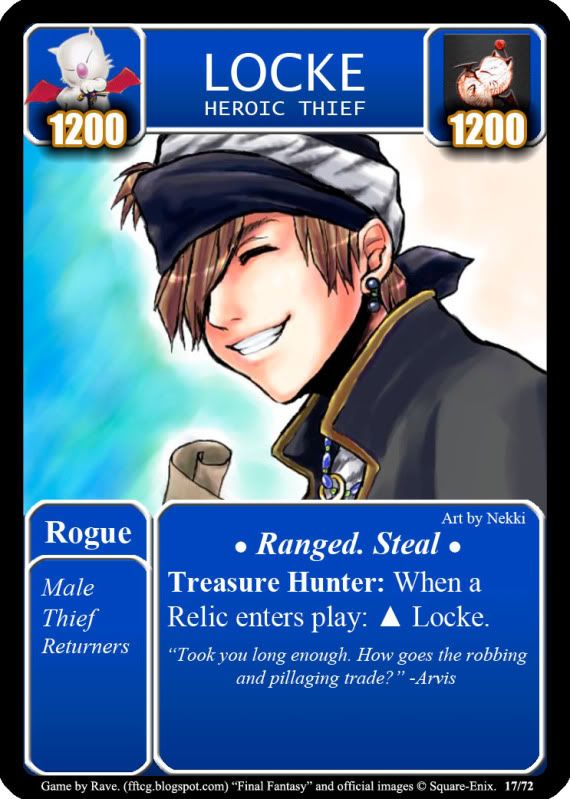
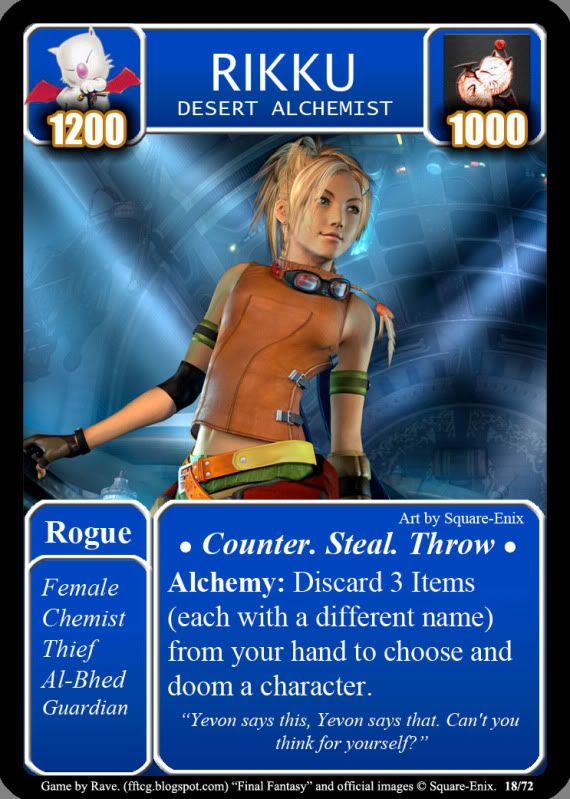
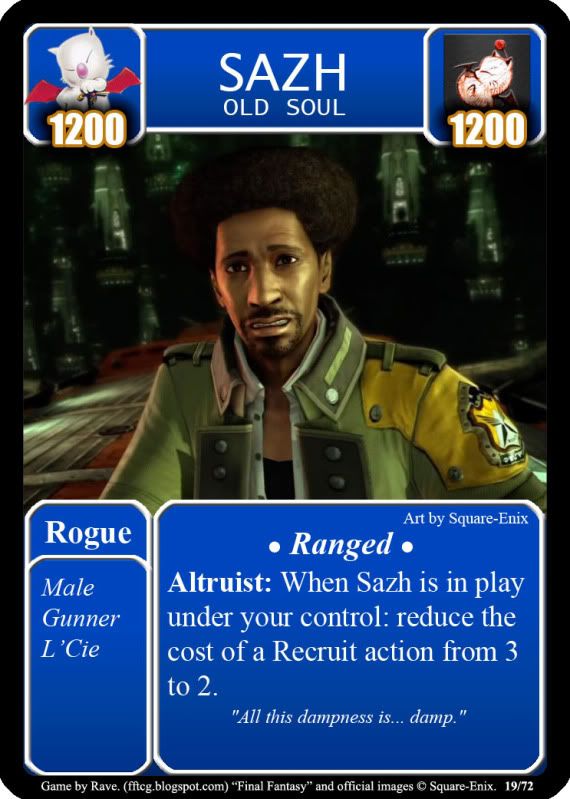
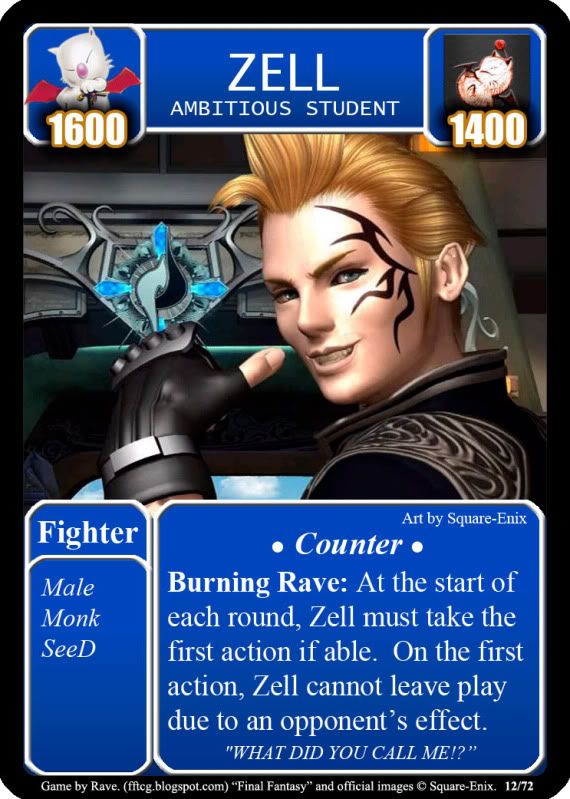
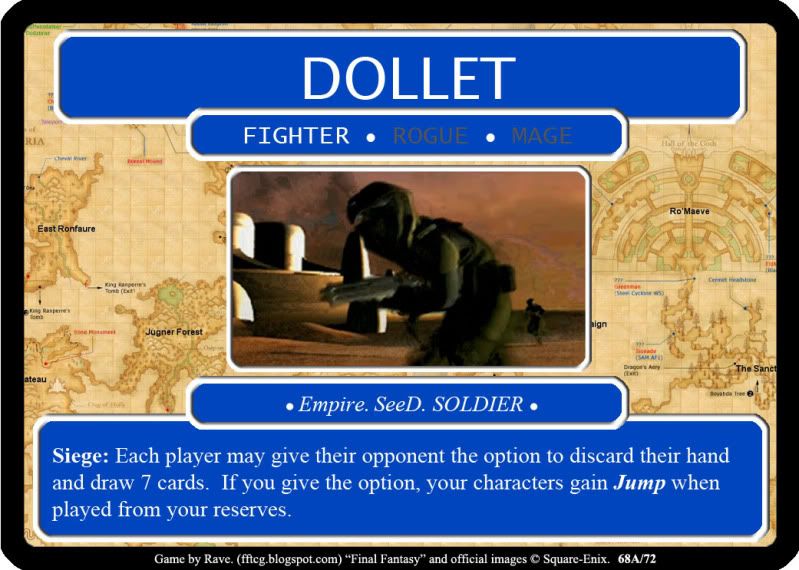
Here is an example of the general look for character cards. I have the character's name, with a title included (So I can also make cards like Cecil: Dark Knight... This is probably my favorite thing about the VS card game.)
The upper right hand corner is where the character's class goes, in this case, Cecil is a fighter. (True, he's got magic, but since his main job is being a human shield, I thought he fit a little better into the fighter category.)
Then we get the trait bar. Cecil has the "White" trait, which doesn't mean he's an Aryan warrior, it means he can use White Magic. The "Black" and "White" magic keywords also grant resistance. (I.e. as long as a character with the "Black" keyword is standing, he is immune to all "Black" magic cards. This doesn't work on Summons though, they'll ruin your shit regardless of who you are.)
Also note that Cecil's ability will eventually be "leader only" I'm working on a uniform way to display effects that are passive, (i.e. always on) triggered, and whether or not those abilities are only useable when one is the leader, like Cecil's ability will be in the final product.
I consider Cecil to be the Captain America of Final Fantasy, there's no greater leader than one that fights on the front lines and would give his life for you.
Anyway, on paper, that's a devestating ability, coupled with Cecil's good defense (most fighters have 1600 attack) you might not be able to do anything while you're getting ranged attacked every turn.
This is a great opportunity to point out my #1 pet peeve with card games. Emulating the source material. There is a VS card of Two-Face which is something like "Flip a coin, heads destroy target character." Wow, some serious design thought there. I think good design involves structuring a character around the game, not the other way around. You want to give them an ability useful to the game, but have it also capture their essense. In this incarnation, Cecil is a tank, you can't get around him, but he doesn't literally cover certain characters and take damage for them.
And them of course, we have the attack icon (Moogle with the Sword) defense (Moogle Shield) and flavor text (One again, not literally.)
And I'd like to take the time to thank all that have read so far. Comments are most definitely welcome. This is only the 2nd card game I've worked on, and the 1st one was horrendous, so your feedback is definitely welcome.
Monday, March 30, 2009
Sorry, that was probably confusing. Now: RULES
I guess I should lay down a basic framework of the rules. I never really set these in stone, but here's an idea of what you can expect.
Relic Phase-
This is the first phase of every round. In this phase, player 1 chooses a relic/location card from his pre-chosen relics, and lays it on the field in front of him location side up. (Player 2 is free to turn over the card and see what the relic is of course, just to see if he wants to commit forces to it)
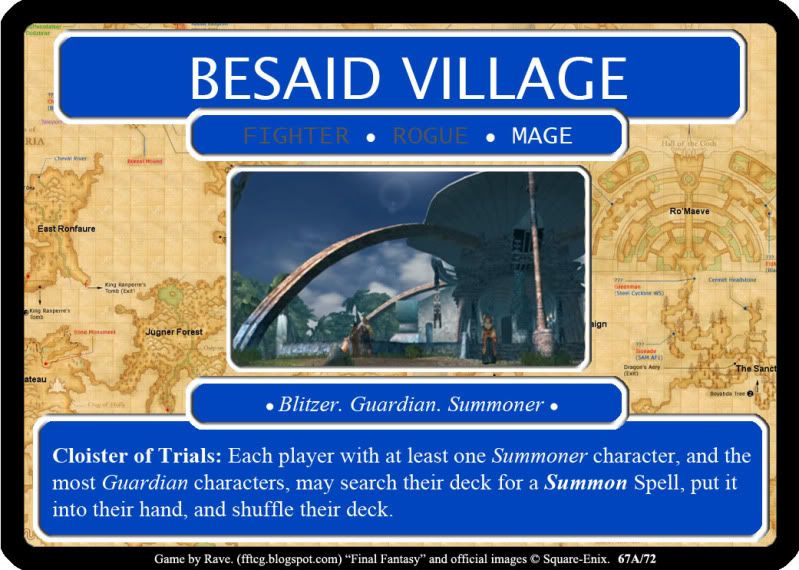
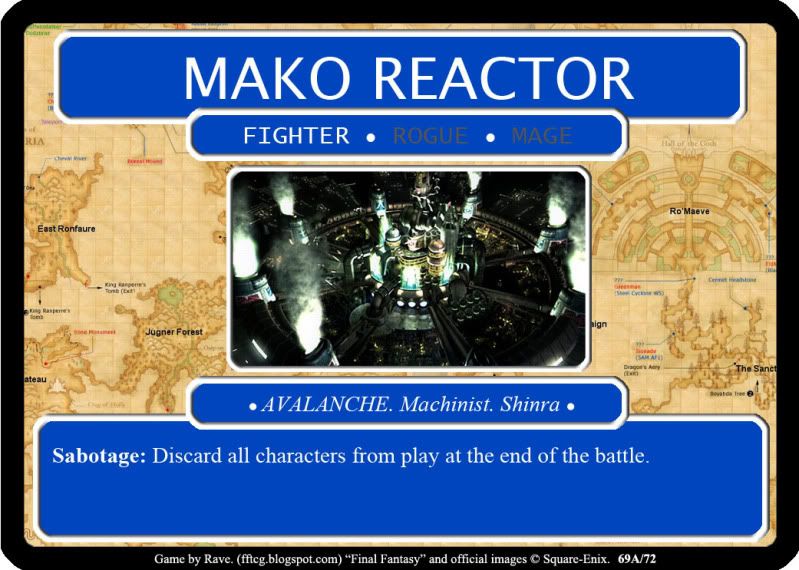
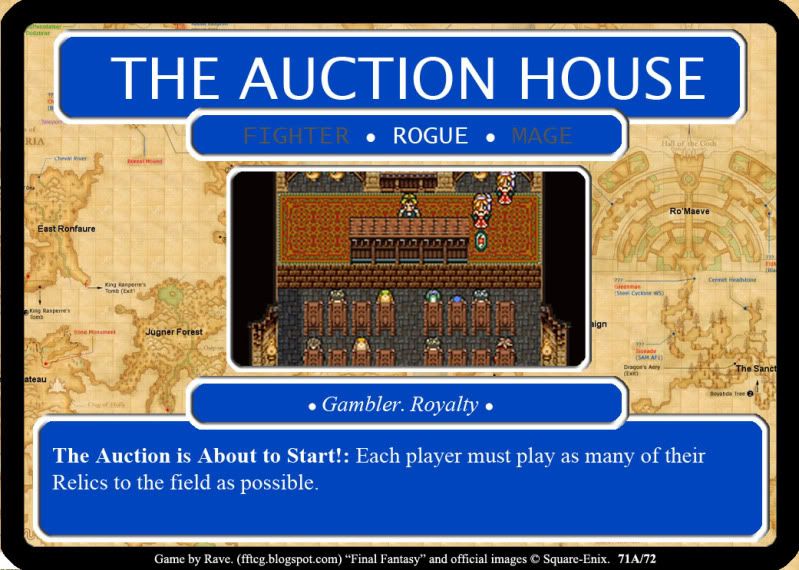
The location cards will have a title, picture, favored class (as i mentioned before), two leadership totals, and a global ability that activates. That probably makes as much sense as Metal Gear, so let me give you an example.
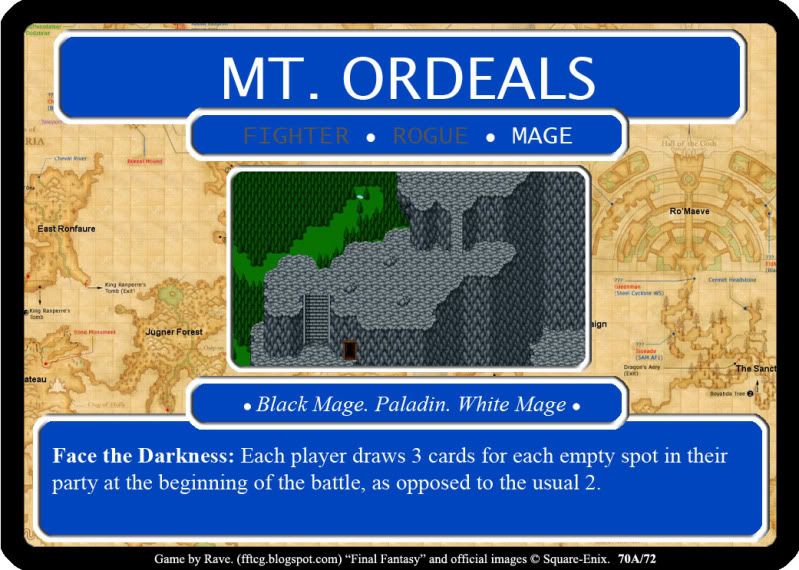
Mount Ordeals
(This is the mountain where Dark Knight Cecil goes in FFIV to become a Paladin... spoiler alert ;P)
Favored Class: Mage (Leadership 2/4)
The favored class mechanic tells you which class is most prepared to deal with the area, and in this case, most prepared to be the leader.
After the card is placed, Player 1 plays a character in his hand that he wants to be the leader of the party, followed by player 2. (If player 2 chooses, he may decline to play a leader, and give the relic to player 1) If that character is a member of the preferred class, you would use the higher unit number (4), otherwise use the lower (2). (This is something I blatently stole from the Starcraft Board Game, I think it's a cool concept, and I hadn't seen it anywhere else)
-This number tells you how many extra characters can join the battle besides the leader. Since you're fighting for the area's relic, it's good to have more forces on your side. So in FFTCG, it will be to your benefit to have a variety of character types.
I've split every character in Final Fantasy into 3 different types, each represented on the card by their sprite in Final Fantasy 1. The 3 classes are just vague representations of the characters. Not all of the thieves are actually thieves, and such, it just is an easy way to group the light armored guys together. The classes don't grant any abilities by themselves, they're there for flavor (not literally) and to set up the aforementioned leader/unit mechanic.
Fighter- This includes all the warmongers, knights, martial artists, abominable snowmen, angry black men etc. (Cloud, Auron, Umaro, and Barret are examples of fighters)
Thief- This includes... well... Thieves, and those considered fighters, but would be more of the archer, ninja or other lightly armored characters.
(Locke, Quistis, Setzer, and Edge are examples of "thieves")
Mage (Specifically Black Mage as far as the sprite goes)-
These are all of the mages, black, white, red, summoner, they will generally have horrible defense, but will let you use magic cards. Magic cards are generally pretty powerful, because they're exhastable, and make you give up some card advantage to use them.
After both players have placed their leaders, player 1 will play out his forces, followed by player 2. (Player 2 gets a serious advantage in this phase, but player 1 played the location/relic, so he has the advantage in that respect.)
Battle Phase-
The battle phase is the meat and potatoes of the game, it is here where you pit each character against each other. Player 1 and 2 simply alternate actions until one side retreats or is destroyed. Every two actions, each player gets to draw a card as well.
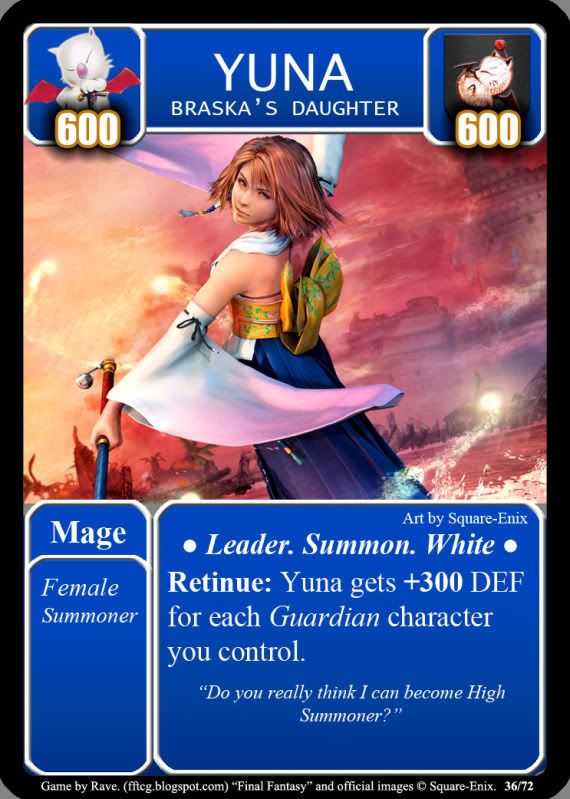
The battle is set up like traditional final fantasy, with a front and back row. The difference is that in the card game, you can't attack the back row at all without a card effect, or the ranged keyword. Yes, this means Umaro can't kill Yuna if she's hiding behind Auron. (Unless he gets a blitzball, oh.... that would not be pretty.) And of course, you can't have a back row without a front row, so when the last character in the front row is defeated, all back row characters will move to the front. (If Umaro defeats Auron, he gets access to the creamy center!)
The actions are as follows
Attack- Pretty simple, you tap the character you want to attack (I'll use MTG terminology for you guys, but the actual cards just use symbols to describe cards tapping, and readying) and then choose an opposing character to get beat on. The defending character gets a free counterattack as well if it's a legal target. (Umaro cant be counter-attacked by Yuna because she has no Ranged keyword, pretty clever Umaro) You just match each attackers attack to each characters defense, if they equal or surpass the number, the character is discarded. (Gotta love that Starcraft board game!) Of course, there will be items, and white magic you can use to keep your characters from being discarded. (If Yuna casts Cure on herself, or Auron uses a potion, she'll be ok and Umaro will be upset. Good thing he wasn't a legal target for a counterattack. Though I doubt she could hurt him with her stick anyway...)
Move-Move one character from a row to the other, could be nice to get a front row shot at a mage, or retreat a thief to the back when a fighter pops up.
Spells/Items- If these can be used, they will say so on the card. Various effects unnecessary to get into now.
Add Character- If you are under your max character limit for the battle determined by the leader, add a character from your hand to battle. (Note: If the leader dies, you lose the higher troop # and are stuck with the low one)
Draw a card- duh. Don't confuse this with the 1 card you get to draw after both players have an action though. This is separate.
Retreat- Return all of your characters to your hand, and forfeit the Relic.
Once only one side remains, the phase ends.
Cleanup Phase- (It will probably be called something else later, but I'll roll with it now.)
All that really happens in this phase, is that the winner returns all living characters to his hand, and takes the relic for himself... and then player 2 starts over and plays his relic...
So here's your basic rule framework. Don't worry, you get a picture next update, as a reward for wading through all of this text.
The basic idea.
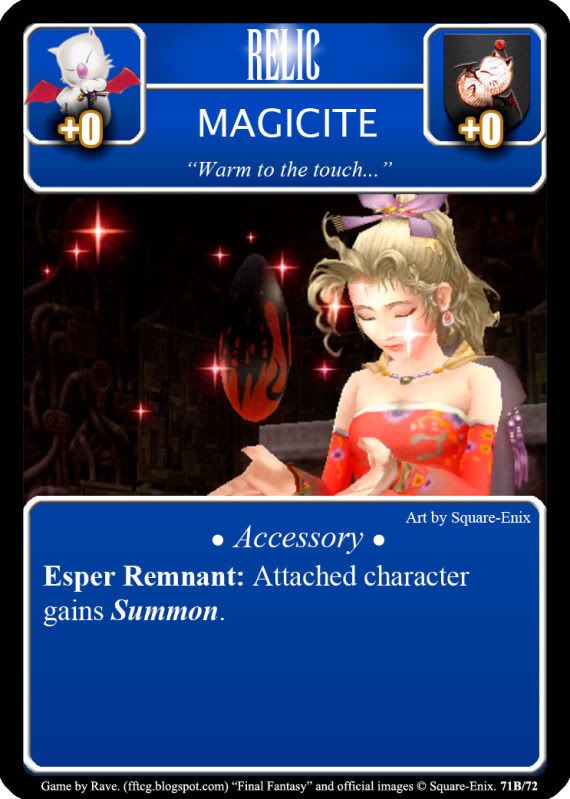
So what I've got going on, is a war game. The victory condition as of now, is to acquire and hold 10 relics from the Final Fantasy series. The relics will be items that have popped up in final fantasy that are integral to the story, or symbolic of the game. (i.e. Blitzball, Magicite, Materia, stuff of that nature)
I guess you could just call them points, but I wanted to make points more than just scorekeeping.
What's the fun of getting relics instead of points if you can't use them? After you win a battle, and the battle's relic, you are free to use the relic on your characters.
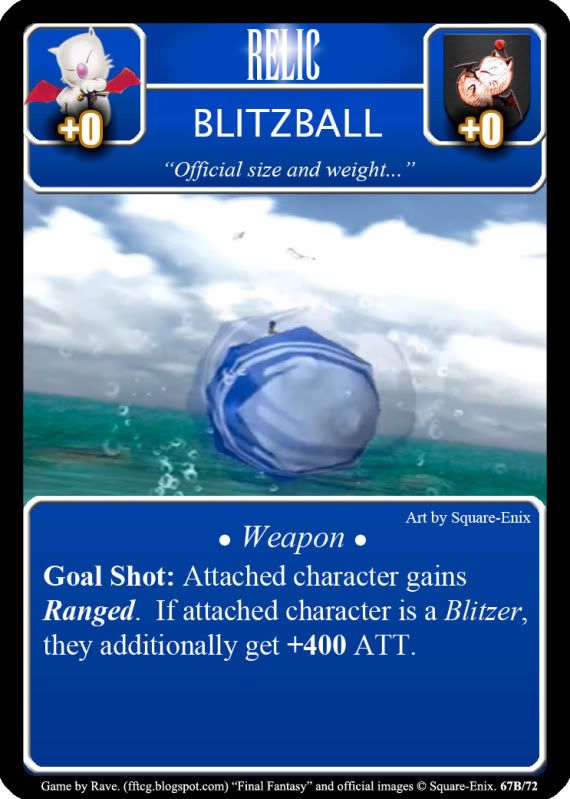
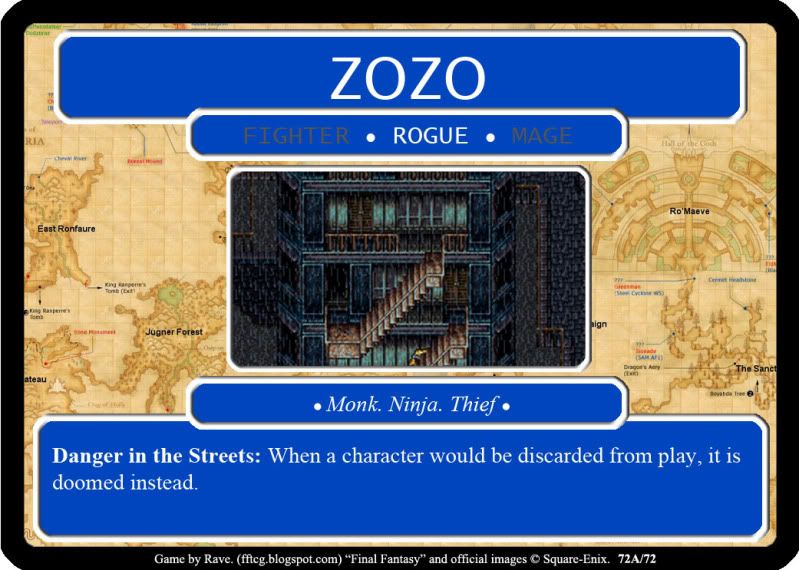
-For example, you fight in the Blitzball Stadium, win, and get the Blitzball relic. (The relic cards will be double-sided, one side with the location, the other with the relic that you recieve after you win) The locations will have traits as well: special effects that only apply to that location, and a preferred class for entering the location. (i.e. Midgar slums are more homely to Thieves than Mages)
The relics themselves are superpowered versions of regular cards you attach to your characters. (think weapons or armor) They're a little broken so far, but I think that adds to the fun. (Wanna cheat a little bit? Give an attack powerhouse like Auron the Blitzball, he'll gain Ranged and be able to shoot directly in the back row, but if he is defeated, you also lose the relic...which means you'll be out 1 point.) I think it will add a little bit of risk/reward to the game, which will be fun.
Subscribe to:
Posts (Atom)